allnewscastallnewscast
Breaking News
AI & Tech

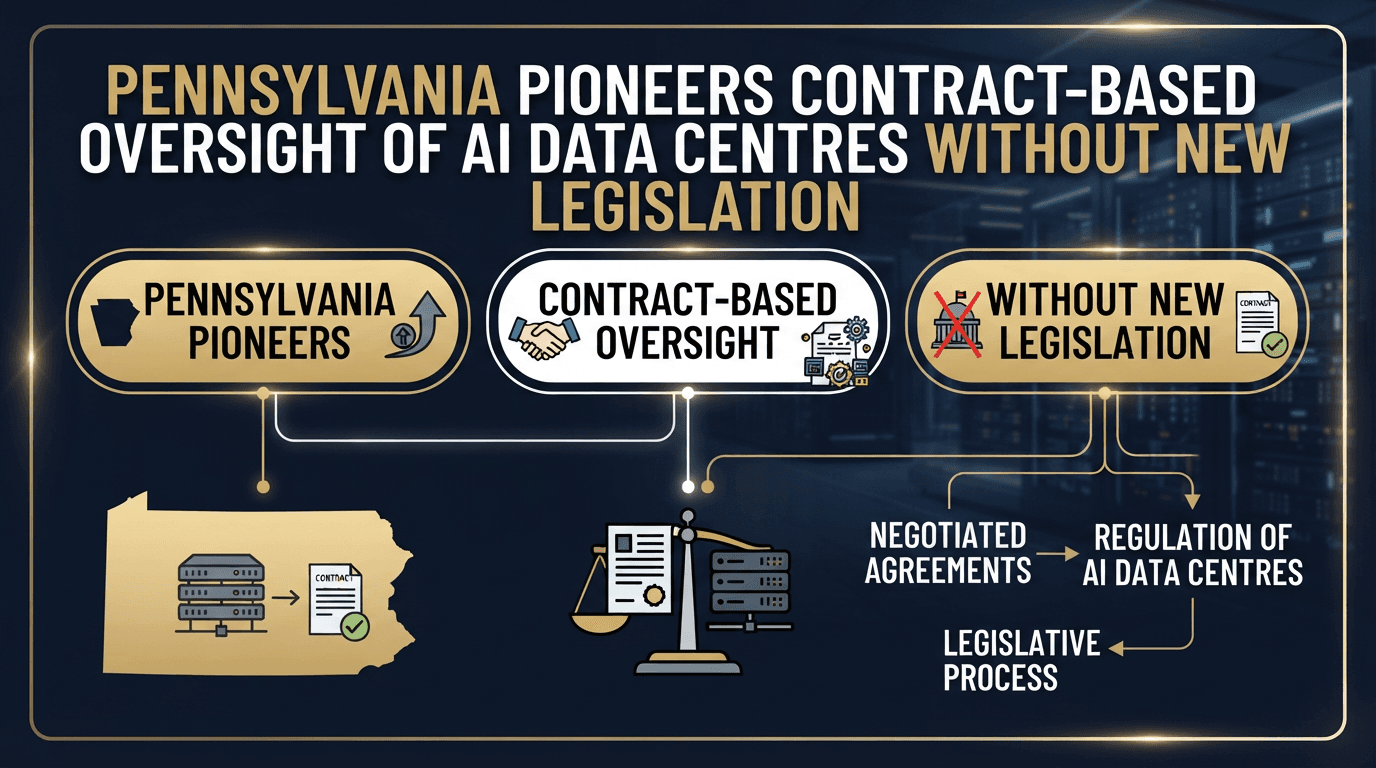
Pennsylvania Pioneers Contract-Based Oversight of AI Data Centres Without New Legislation
Nic Reeve6 min read
Pennsylvania Pioneers Contract-Based Oversight of AI Data Centres Without New Legislation

AI data centre oversight in the United States has taken a significant step forward in Pennsylvania, where the governor has used existing environmental permitting powers to impose binding conditions on new AI facilities—without the legislature passing a new statute. Policy experts say the approach could become a template for other states looking to manage the rapid expansion of AI infrastructure while broader federal legislation is still pending.

Governor’s Order Creates a Contract-Based Regime

According to reporting from AI News, the Pennsylvania model is built around a new executive order that changes how the state’s Department of Environmental Protection (DEP) handles permit applications from proposed data centres. Under the order, DEP will review applications only when developers have:

  • Committed to the Governor’s Responsible Infrastructure Development (GRID) Requirements via a formal Consent Order and Agreement.
  • Already secured local approval for the project.

The consent agreement functions as a legally enforceable contract between the data centre operator and the state, locking in a defined set of obligations on issues such as environmental impact, community engagement, and transparency. The order took effect immediately and now applies to all new relevant permit applications, meaning that in practice, AI data centre regulation in Pennsylvania “begins with a signature.”

Crucially, the governor did not seek new legislation to create this framework. Instead, the order relies on permitting authority the state already holds under existing environmental and land-use laws. Analysts argue that this makes the Pennsylvania order a potentially portable template for other jurisdictions that have similar permitting powers but lack political consensus for new statutes.

Why AI Data Centres Are Under Scrutiny

The Pennsylvania order arrives amid growing concern over the pace and impact of AI data centre construction nationwide. A recent tracker of AI data centre legislation in the United States lists 16 bills across eight states, including measures focused on environmental accountability, energy disclosure, and even temporary moratoriums on new builds. As AI workloads surge, these facilities can draw huge amounts of electricity and water, raising questions about grid stability, climate goals, and local resources.

At the federal level, multiple bills seek to address these pressures. The proposed AI Data Center Site Selection Transparency Act of 2026 would require developers of AI-focused data centres to disclose their planned locations and expected energy and water use at least 180 days before taking “definitive” steps to establish a facility. Other proposals, such as the Artificial Intelligence Data Center Moratorium Act, aim to pause new AI data centre construction until laws are in place to protect communities, prevent environmental harm, and bar government subsidies for AI centres that do not meet strict safeguards.

In parallel, a broader federal roadmap on “responsible innovation” has floated ideas like a Data Center Tax Accountability and Disclosure Act of 2026, which would mandate detailed reporting on energy and water consumption, funnel data into annual public reports, and allow the Department of Energy and Environmental Protection Agency to fine operators that fail to comply. Taken together, these efforts underscore how AI infrastructure has become a focal point in debates over climate policy, industrial strategy, and AI governance.

How the Pennsylvania Template Works in Practice

By conditioning permit review on a signed GRID consent agreement, Pennsylvania effectively front-loads regulatory control into the earliest stages of AI data centre development. Before DEP even opens a file, the developer must accept a pre-defined package of requirements, which can cover:

  • Commitments on energy efficiency and renewable sourcing.
  • Limits or reporting obligations on water use.
  • Community benefit agreements or local hiring targets.
  • Procedures for ongoing monitoring and enforcement.

While the specific GRID requirements are detailed in a template agreement released alongside the order, AI News reports that the mechanism is intentionally designed to be replicable: it uses standard consent order tools familiar to environmental regulators, applied to the new context of AI data centres. Because consent orders are already widely used to enforce pollution controls and remediation plans, regulators can adapt established legal practices rather than invent entirely new structures.

The order also requires that local approval be secured before state environmental permitting proceeds. This sequencing gives municipalities leverage and ensures that local land-use decisions are not overridden by state-level enthusiasm for AI investment. In effect, communities gain a veto point early in the process, aligning with demands from activists and local officials who have pushed for stronger say over major infrastructure projects.

A Contrast With Moratorium and Tax-Based Approaches

Pennsylvania’s approach differs sharply from the federal moratorium proposals now before Congress. The Artificial Intelligence Data Center Moratorium Act and companion House legislation would halt construction or upgrading of AI data centres until new national safeguards are enacted, including guarantees that communities can approve or reject projects, that facilities do not raise utility bills or exacerbate climate risks, and that no government subsidies support non-compliant centres. Those bills aim to reset the entire legal landscape around AI infrastructure, but they require full congressional passage.

By contrast, Pennsylvania’s template works within existing law, targeting the permitting gate rather than construction itself. It does not stop AI data centres outright, but it binds them to pre-negotiated obligations that can be updated administratively. For states wary of freezing economic development but concerned about environmental and social impacts, this may appear more politically feasible than a blanket moratorium.

The federal tax-and-disclosure proposals, including the Data Center Tax Accountability and Disclosure concept, would add another layer by requiring detailed reporting and adjusting tax treatment for AI data centre property, potentially diverting funds to a workforce transition program. Observers suggest that a future regulatory environment could combine all three elements: contract-based state permitting models like Pennsylvania’s, national disclosure mandates, and targeted fiscal measures to balance local costs and benefits.

Implications for Other States and the AI Industry

Policy commentators at Age for AI and AI Business note that the key innovation in Pennsylvania is less about the substance of the GRID requirements and more about the procedural tactic: using existing permitting authority and consent agreements as a lever to regulate AI data centres immediately. Because no new law was required, the state could act quickly, setting conditions for all new applications from the day the order was issued.

Other states with strong environmental permitting regimes could adopt similar templates, tailoring their consent orders to local priorities such as drought risk, grid reliability, or community benefits. For AI companies and cloud providers, this implies a patchwork of contract-based obligations that may vary by state—even as federal lawmakers debate broader rules.

Industry leaders are watching closely. While many companies have voluntarily announced plans to power data centres with renewable energy and improve efficiency, the Pennsylvania order transforms such commitments into enforceable requirements tied to the right to build. As more states experiment with similar tools, developers may face escalating demands for transparency and accountability as the price of continued expansion of AI infrastructure.

With AI data centres now central to the global digital economy, Pennsylvania’s move offers a concrete, immediately deployable model for governments seeking to manage their growth rather than simply observe it. Whether other states follow this template—or opt for stronger measures like moratoriums—will shape how and where the next wave of AI infrastructure is built.

Read more →

Related Articles

AInews: Bullish Steps Into AI Hardware Lending With $100M USD.AI Facility
AI & Tech

AInews: Bullish Steps Into AI Hardware Lending With $100M USD.AI Facility

AInews: Bullish Steps Into AI Hardware Lending With $100M USD.AI Facility On August 28, 2026, crypto exchange Bullish announced a $100 million stablecoin debt facility for USD.AI, marking its formal expansion from digital asset trading into AI infrastructure lending and putting the AInews spotlight on GPU-backed loans for high‑performance computing. What exactly did Bullish agree to do with USD.AI? Bullish committed a $100 million stablecoin-based liquidity facility that USD.AI will draw on to originate non‑recourse loans secured by GPU hardware and other AI compute equipment. The capital comes from Bullish’s balance sheet and exchange liquidity, channeling on‑chain funds directly into physical AI infrastructure. According to Bullish’s August 28, 2026 announcement, the firm will provide up to $100 million in stablecoins to USD.AI, an on‑chain protocol that finances AI data centers by lending against graphics processing units (GPUs) and related servers. USD.AI describes its loans as “non‑recourse” and “asset‑backed,” meaning borrowers pledge the hardware itself, not wider corporate assets, as collateral for the debt. Facility size: $100 million in stablecoins, according to Bullish and USD.AI on August 28, 2026. Collateral: NVIDIA GPUs and other high‑performance computing hardware used for AI workloads, according to CoinMarketCap’s update from August 28, 2026. Loan structure: On‑chain, non‑recourse loans where the hardware backs the debt, according to USD.AI and The Defiant. Purpose: Funding the “AI buildout” by providing capital directly to AI infrastructure operators, according to USD.AI’s social posts on August 28, 2026. Bullish framed the move as a strategic entry into “middle‑market AI infrastructure financing,” pairing its crypto capital markets expertise with USD.AI’s on‑chain lending technology. The arrangement connects stablecoin liquidity with demand from AI data centers that struggle to fund expensive GPU clusters quickly through traditional bank channels. How does USD.AI’s GPU-backed lending model work in practice? USD.AI originates loans where AI data center operators pledge GPU hardware as collateral. If borrowers default, USD.AI’s protocol can liquidate the equipment or associated cash flows. The Bullish facility increases the protocol’s capacity to fund new loans and expand its on‑chain balance sheet. USD.AI positions itself as an “on‑chain platform for AI infrastructure financing” that locks up real‑world computing gear inside crypto‑native loan structures. According to USD.AI and CoinMarketCap, the protocol focuses on NVIDIA GPU rigs that power training and inference for large models, treating the hardware’s resale value and generated revenue as the economic foundation for the loans. Loan origination: USD.AI issues non‑recourse loans directly to AI infrastructure operators, according to Unite.AI’s August 28, 2026 report. Collateral management: GPU servers and associated computing assets are pledged on‑chain and can be liquidated if the borrower fails, according to The Defiant. Protocol scale: Cointelegraph reported on August 28, 2026 that USD.AI had “over $225 million” in total value locked at the time of the Bullish facility. Token ecosystem: USD.AI issues sUSDai, a yield‑bearing staked dollar token linked to protocol revenues, according to Unite.AI and Stock Titan. This structure aims to speed up capital formation for AI hardware deployments by reducing the reliance on long underwriting cycles and conventional secured lending that often require broader corporate guarantees. Instead, USD.AI uses programmable smart contracts and crypto liquidity to move funding faster, while Bullish supplies the stablecoin capital pool. Why is Bullish moving from pure crypto trading into AI infrastructure lending? Bullish argues that demand for AI computing capacity is outstripping traditional financing channels. By tying stablecoin liquidity directly to GPU assets, the firm hopes to capture growth in AI capital expenditure while leveraging its exchange, balance sheet and market‑making capabilities. The August 28, 2026 announcement describes the facility as Bullish’s “strategic entry” into middle‑market AI infrastructure financing, a new line of business beyond its core exchange operations. MarketBeat’s coverage of the deal notes that the company is seeking exposure to rising demand for GPU capacity while accepting lending risk linked to the underlying hardware and borrowers’ performance. Strategic rationale: Connect digital asset capital markets with physical AI compute demand, according to Stock Titan’s summary of Bullish’s press release. Risk profile: Lending against volatile hardware prices and AI operator cash flows, as highlighted by MarketBeat’s August 30, 2026 analysis. Market reaction: Bullish shares on the NYSE ticker BLSH drew investor attention after the announcement, according to MarketBeat’s news page dated August 30, 2026. Crypto analysts quoted by Cointelegraph and CoinDesk social posts described the arrangement as a step toward linking “crypto capital markets directly to physical AI compute,” using GPUs as loan collateral and turning a previously niche lending model into a more institutional product. What role does the sUSDai token play in the Bullish–USD.AI arrangement? sUSDai is USD.AI’s staked dollar token that represents claims on protocol revenues and underlying assets. Bullish plans to list sUSDai across multiple trading pairs and run a market‑making program aimed at improving liquidity, price discovery and funding efficiency for GPU‑backed debt. Unite.AI reported that Bullish will “onboard sUSDai” on its exchange, offering several trading pairs backed by an internal market‑making desk. Stock Titan’s reading of the press release adds that this initiative is designed to improve “secondary liquidity and price discovery for GPU‑backed debt,” effectively turning slices of infrastructure loans into tradable on‑chain instruments. Token type: Yield‑bearing staked dollar representing protocol exposure, according to Unite.AI’s August 28, 2026 article. Exchange listing: Planned listing on Bullish with multiple trading pairs and a dedicated market‑making program, according to Stock Titan and CoinMarketCap. Capital recycling: As sUSDai gains deeper liquidity, USD.AI can originate more loans and roll over existing exposure, according to Unite.AI. The Defiant reported that USD.AI said Bullish would “mint $100 million of sUSDai” as part of the facility, using that capital pool as fuel for a larger pipeline of GPU‑backed loans tied to the ongoing AI buildout. That structure turns Bullish into both lender and major token holder in USD.AI’s ecosystem. How does this deal build on Bullish’s earlier investment in USD.AI? Bullish first invested $4 million in USD.AI in September 2025, calling it its first post‑IPO venture bet. The new $100 million facility extends that relationship from minority equity to core financing partner for USD.AI’s lending operations. According to a Bullish news release dated September 22, 2025, the exchange committed $4 million to USD.AI as its first investment after listing on the New York Stock Exchange under ticker BLSH. Bullish described USD.AI at the time as “the on‑chain platform for AI infrastructure financing,” signalling interest in the intersection of digital assets and AI hardware before the larger debt facility was conceived. Initial equity commitment: $4 million investment announced September 22, 2025, according to Bullish and USD.AI social posts. Strategic intent in 2025: Explore AI infrastructure financing using on‑chain tools, according to Bullish’s corporate statement. 2026 escalation: A twenty‑five‑fold increase in capital commitment via the $100 million stablecoin facility, according to the August 28, 2026 press release. The continuity between the 2025 equity stake and the 2026 debt facility shows a calculated move rather than a sudden pivot. Bullish has spent roughly a year deepening ties with USD.AI’s team and technology before committing a nine‑figure lending facility. Who stands to benefit from this AI hardware lending expansion? The primary beneficiaries are AI infrastructure operators that need capital for GPU clusters, along with investors seeking exposure to AI hardware economics via on‑chain instruments. Bullish aims to capture trading and lending fees, while USD.AI expands its loan book and protocol revenues. USD.AI’s model targets data center operators, model‑hosting providers and specialized GPU cloud platforms that face steep upfront hardware costs. According to CoinMarketCap and Unite.AI, the protocol’s loans can finance “high‑performance computing assets” directly, reducing reliance on general corporate credit. The Bullish facility enlarges the pool of available capital for this segment. Borrowers: Middle‑market AI compute firms and infrastructure providers, according to Bullish’s description of the new business line. Token holders: sUSDai holders gain exposure to GPU‑backed lending returns and protocol fees, according to Unite.AI. Exchange users: Bullish customers get new trading pairs and an asset class tied to AI hardware performance, according to Stock Titan. Cointelegraph and CoinDesk coverage emphasise that the deal creates a bridge between crypto liquidity providers and the real‑world AI buildout, potentially giving smaller AI firms more options than conventional bank loans or equity dilution. What risks and unanswered questions surround this new lending model? The structure introduces exposure to hardware price swings, borrower defaults and smart contract vulnerabilities. MarketBeat notes that while investors welcomed Bullish’s entry into AI financing, the company is now directly tied to the economics and operational risks of GPU‑heavy infrastructure. AI hardware prices can move sharply as new GPU generations arrive or demand cycles change. CoinMarketCap’s commentary on the facility warns that using NVIDIA GPUs as collateral ties loans to both technology refresh cycles and secondary market liquidity for used equipment. If resale values fall faster than expected, recovery on defaulted loans could be lower. Credit risk: AI operators may struggle if customer demand or model economics weaken, affecting their ability to service loans, according to MarketBeat’s August 30, 2026 note. Market risk: Collateral value depends on ongoing demand for GPUs and AI compute, according to CoinMarketCap. Protocol risk: On‑chain structures rely on smart contracts and oracle data, which could fail or be attacked, a concern raised in DeFi‑focused coverage by The Defiant. At the same time, cryptorank.io and Cointelegraph coverage frames the facility as a test case for whether crypto‑native lending can safely support real‑world capex in high‑growth sectors. The coming quarters will reveal whether hardware‑backed stablecoin lending scales beyond this initial $100 million commitment. What happens next for Bullish, USD.AI and AI infrastructure financing? The two firms plan joint research into capital formation models for AI hardware, broader sUSDai integration on Bullish, and further scaling of GPU‑backed loans. Future steps may include expanding facility size, onboarding more borrowers and refining risk management as the protocol matures. Stock Titan’s summary of Bullish’s press release says the partners intend to “expand joint research on capital formation models for AI CapEx,” linking on‑chain liquidity tools with the financing needs of machine learning infrastructure. The Defiant reports that USD.AI is already using newly minted sUSDai to fund more GPU loans, suggesting an active pipeline of deals. Near‑term focus: Deploying the full $100 million facility into GPU‑backed loans, according to Unite.AI. Token rollout: Listing sUSDai pairs and building a liquid secondary market for AI hardware‑linked debt, according to Stock Titan and CoinMarketCap. Potential expansion: MarketBeat and Cointelegraph commentary hint that, if the model works, Bullish could increase the facility or replicate it with other AI infrastructure protocols. How regulators and traditional lenders respond to crypto‑funded AI hardware lending remains unclear. For now, Bullish and USD.AI are positioning themselves as early movers at the intersection of digital asset markets, tokenised debt and the physical machines driving contemporary AI systems.

Nic Reeve·
AInews showdown: Gemini Omni Flash or Kling 3.0 for next‑gen video control?
AI & Tech

AInews showdown: Gemini Omni Flash or Kling 3.0 for next‑gen video control?

AInews showdown: Gemini Omni Flash or Kling 3.0 for next‑gen video control? On 19 May 2026, Google began rolling out Gemini Omni Flash to its apps and APIs for conversational video generation and editing, while Kuaishou’s Kling 3.0, launched on 4–5 February 2026, pushed multi‑shot continuity and cinematic storyboards into the mainstream AInews race. What exactly are Gemini Omni Flash and Kling 3.0? Gemini Omni Flash is Google’s fast, text‑and‑image‑to‑video model built for interactive editing, now generally available as Gemini Omni 1.1 Flash. Kling 3.0 is Kuaishou’s third‑generation family of multimodal video and image models, centered on the Video 3.0 and Video 3.0 Omni engines for short, native 4K clips with storyboard controls. Both systems sit at the frontier of AI video. According to Google’s Gemini model announcement in May 2026, Gemini Omni Flash turns text prompts and optional reference images into short video clips and lets users "easily edit your videos through conversation" in the Gemini app, Google Flow and YouTube tools. According to Google’s developer documentation, the Gemini Omni Flash API is described as a video "generation and editing" model that refines clips via natural‑language conversations and supports video extension. According to Google’s August 27, 2026 release notes, Gemini Omni 1.1 Flash has reached general availability and replaces the earlier preview endpoint, which will be deprecated on September 30, 2026. According to AI Wiki’s Kling 3.0 entry updated September 11, 2026, Kling 3.0 includes Video 3.0, Video 3.0 Omni, Image 3.0 and Image 3.0 Omni, all built on a unified multimodal architecture that outputs short clips with native 4K resolution and synchronized multilingual audio. According to Genra’s February 20, 2026 guide, Kuaishou timed the Kling 3.0 public release to February 5, 2026, with text‑to‑video, image‑to‑video and reference‑driven modes across the lineup. How does Gemini Omni Flash handle video editing and user control? Gemini Omni Flash focuses on conversational editing: users can ask for changes, extend scenes, and adjust frames using natural language, with support for incremental 10‑second extensions up to 40 seconds in Gemini Omni 1.1 Flash. This makes Google’s model feel like an interactive editor rather than a one‑shot generator. Editing in Gemini’s ecosystem is built around back‑and‑forth dialogue. According to Google’s Omni 1.1 Flash blog on August 27, 2026, the model delivers "studio‑quality video production" and lets users extend videos in 10‑second increments, up to a cumulative 40 seconds, while analyzing up to 10 seconds of prior context instead of just the last second. According to the same post, Gemini Omni 1.1 supports features such as first‑and‑last‑frame interpolation and 4K output in supported environments, improving continuity between edits. According to Google’s Gemini Omni product blog from May 19, 2026, users can "easily edit your videos through conversation" and are already seeing the model integrated into the Gemini app, Google Flow and YouTube Shorts, with rollout to Google AI Plus, Pro and Ultra subscribers globally and free use in some YouTube tools. According to the Gemini Omni Flash API documentation, developers can refine and edit generated videos by sending natural‑language instructions in an ongoing interaction, positioning the model as a dynamic editor that supports video extension as well as generation. According to a July 16, 2026 Google Workspace announcement, Gemini Omni Flash now powers Google Vids, where users can edit videos using simple text prompts and generate new clips featuring personal avatars that look and sound like them. According to ilisai’s explainer updated September 2, 2026, the service’s video generator now uses Gemini Omni 1.1 Flash and bills at least 10 seconds per clip, indicating that Google’s fast model is already deployed in third‑party platforms. This conversational workflow favors creators who expect to iterate rapidly, like social video editors or marketing teams that want many small changes without rebuilding clips from scratch. What does Kling 3.0 offer in multi‑shot continuity and storyboarding? Kling 3.0’s Video 3.0 and Video 3.0 Omni models emphasize multi‑shot generation: up to six connected shots in a single clip, with stable character identity, lighting and environment across cuts. Shot planning can be automatic or fully custom, turning prompts into structured mini‑sequences. Multi‑shot tools make Kling feel like a pre‑visualization engine for directors. According to Kling’s Video 3.0 user guide last updated August 26, 2026, the model supports two modes for multi‑shot video: "Multi‑Shot" and "Custom Multi‑Shot". When Multi‑Shot is enabled, it automatically plans transitions and creates multi‑scene content; Custom Multi‑Shot lets users configure shot counts and durations. According to Kling’s July 28, 2026 multi‑shot guide, Multi‑Shot structures a scene through camera coverage, shot changes and narrative progression, reading coverage and shot information from the prompt to adjust angles and compositions for cinematic storytelling. According to Morphic’s August 2026 Kling 3.0 guide, Kling Video 3.0 supports multi‑shot sequences of up to six camera cuts per generation, with text‑to‑video, image‑to‑video and start‑and‑end‑frame‑to‑video modes within a maximum duration of 15 seconds per clip. According to Invideo’s May 28, 2026 overview, Kling 3.0 can generate up to six connected shots while letting users either describe the scene and let the model plan cuts or specify each shot’s framing, duration and camera movement for precise shot‑list execution. According to Kling3Pro’s March 26, 2026 feature page, Kling 3.0 multi‑shot generation defines up to six individual shots inside a single 15‑second clip, each with its own prompt and camera angle, while locking character appearance, wardrobe and environment continuity via scene‑level identity encoding. According to AI Wiki and Synthszr’s product ranking updated September 6, 2026, Kling 3.0’s unified architecture produces native 4K video at up to 60 frames per second and supports multi‑shot storyboards with up to six camera cuts, reinforcing its role in high‑fidelity continuity. These continuity guarantees matter for ad agencies, pre‑viz teams and independent filmmakers that need a sequence of connected shots, not just isolated clips. How do lengths, resolution and audio capabilities compare? Gemini Omni Flash emphasizes flexible duration via extensions and focuses on fast 720p clips in many deployed services, while Kling 3.0 centers on short but dense native 4K sequences up to 15 seconds with synchronized multilingual audio. The technical trade‑offs shift who benefits most from each system. According to Google’s Omni 1.1 Flash blog, users can extend a video by 10‑second increments, up to 40 seconds total, with Omni analyzing up to 10 seconds of prior context to keep motion and composition aligned. According to ilisai’s July 19, 2026 article, the original Gemini Omni Flash preview produced short 720p clips from text prompts or reference images and, as of a September 1 update, every video generated with Gemini Omni 1.1 Flash bills at least 10 seconds of output. According to AI Wiki’s Kling 3.0 profile, the new generation moved from roughly 10‑second 1080p clips in Kling 2.6 to 15‑second native 4K clips in Kling 3.0, adding synchronized lip‑synced audio across five languages. According to Morphic’s technical table, Kling 3.0’s Video 3.0 model supports durations between 3 and 15 seconds, aspect ratios such as 16:9, 9:16 and 1:1, and native 4K resolution with other options at 1080p and 720p. According to Synthszr’s September 6, 2026 ranking, Kling 3.0 natively generates 4K video at up to 60 frames per second with synchronized audio and supports up to six camera cuts per clip. Users chasing maximum resolution and integrated audio will lean toward Kling; teams optimizing for iterative editing inside existing Google tools may accept lower resolution in exchange for speed and integration. Where are these models available and how are they priced? Gemini Omni Flash is woven into Google’s subscription tiers and tools, from the Gemini app to YouTube products and Google Vids, while Kling 3.0 is accessible through Kuaishou’s platforms and partner APIs aimed at creators and developers. Commercial terms vary, but both target professional and prosumer use. According to Google’s May 19, 2026 Gemini Omni launch blog, Gemini Omni Flash started rolling out to Google AI Plus, Pro and Ultra subscribers globally through the Gemini app and Google Flow, and became available at no cost in YouTube Shorts and the YouTube Create app. According to the July 16, 2026 Google Workspace blog, Gemini Omni Flash now powers Google Vids, giving Workspace users access to text‑prompt‑based editing and avatar generation within a productivity suite. According to Gemini API release notes, Gemini Omni 1.1 Flash reached general availability in early September 2026, signaling that production billing and quotas now apply as the preview endpoint approaches deprecation. According to Kuaishou’s February 9, 2026 feature guide, Kling 3.0 was officially launched on February 4, 2026 at 11:00 PM Beijing time, with API access for developers beginning February 5, 2026. According to Genra’s February 20, 2026 overview, Kling 3.0’s rollout prioritized "Ultra" subscribers before opening more broadly, positioning the models as premium tools for serious creators. According to Morphic’s guide, third‑party platforms integrate Kling 3.0’s modes into their own interfaces, offering creators control over duration, resolution and multi‑shot features alongside their own pricing. According to Synthszr’s September 2026 ranking, Kling 3.0 appears in AI product lists targeted at production users, indicating its positioning in professional and semi‑professional video workflows. These distribution strategies matter. Google is tying video AI tightly to its productivity and social stacks, while Kuaishou and its partners push Kling into dedicated creative and editing environments where users may build entire pipelines around it. Who gains more from editing flexibility, and who needs multi‑shot continuity? Creators who iterate quickly on single clips—with frequent text‑driven tweaks, avatar changes and scene extensions—gain most from Gemini Omni Flash’s conversational editing and deep integration in Google tools. Teams planning storyboards or ad sequences benefit more from Kling 3.0’s multi‑shot continuity and 4K, audio‑rich outputs. Different workflows point to different winners. For social managers and short‑form creators inside YouTube and Workspace, Gemini’s ability to extend scenes, interpolate frames and apply natural‑language edits—"make this shot closer," "brighten the background"—reduces friction in turning rough ideas into polished clips. For cinematographers, agencies and pre‑viz teams, Kling’s combination of up to six connected shots, locked character identity and 4K visuals means they can block out miniature storyboards, test camera coverage and maintain continuity shot by shot. According to Invideo’s comparison, Kling 3.0 explicitly contrasts multi‑shot support against single‑shot models, highlighting that it can either auto‑plan coverage or follow a detailed human‑written shot list. According to Google’s Omni 1.1 blog, the extended context window and interpolation tools are framed around "studio‑quality" production for creators who may not want to think in discrete shots but still care about smooth motion and consistent framing in the finished video. No single model wins outright. The choice turns on whether a creative team thinks in clips with conversational edits or in sequences of shots with tight continuity and high‑end visuals.

Nic Reeve·
Google adds xAI’s Grok 4.6 to its enterprise agent marketplace
AI & Tech

Google adds xAI’s Grok 4.6 to its enterprise agent marketplace

Google’s enterprise AI platform has added support for xAI’s Grok 4.6, expanding the model choices available to business users building agents and automations. The new listing appears in Google’s Gemini Enterprise Agent Platform documentation and places Grok 4.6 in the platform’s Model Garden, where developers can access third-party models alongside Google’s own offerings. According to xAI and Google documentation published this week, Grok 4.6 is positioned as xAI’s most capable model for coding, agentic tasks and knowledge work. The model is described as being built for long-running agents and more ambitious interactive and visual work, with a 500,000-token context window and configurable reasoning levels labeled low, medium, high and xhigh. The addition matters because enterprise teams increasingly want a single environment where they can compare and deploy multiple frontier models without rewriting their entire workflow. By making Grok 4.6 available inside Google’s enterprise agent stack, Google is giving customers another option for tasks that may benefit from longer context handling, multi-step reasoning and tool use. The model is also surfaced with a dedicated publisher-style entry, indicating that it can be selected and managed through the platform’s standard model browsing interface. xAI’s own release materials say Grok 4.6 is available through the xAI API and partner services, with pricing set at $2 per million input tokens, $0.50 per million cached input tokens and $6 per million output tokens for prompts under 200,000 tokens. For larger prompts of 200,000 tokens or more, xAI says pricing rises to $4 per million input tokens, $1 per million cached input tokens and $12 per million output tokens. Google’s documentation mirrors the availability, listing Grok 4.6 in preview inside Model Garden. The model’s arrival on Google’s platform follows a broader rollout that xAI announced earlier in August. In its release notes, xAI said Grok 4.6 is intended for coding, agentic tasks and knowledge work, and that it supports text and image input with text-only output. The company also says the model has no stated text output limit and includes tools such as function calling, web search, X search and code execution. For enterprise customers, the practical appeal is straightforward: Grok 4.6 is being offered as a high-capacity model for jobs that stretch over long sessions, such as software development, research synthesis and multi-step workflow automation. The 500,000-token window gives the model room to hold far more context than many standard systems, while the reasoning controls allow users to adjust how aggressively the model thinks before responding. Google has not said Grok 4.6 will replace any existing models on the platform, and the documentation frames the addition as another selectable option rather than a default. That means enterprise teams can test it against other models already in the platform for quality, latency and cost before deciding where it fits best. The move also underscores how cloud AI marketplaces are evolving into neutral distribution channels for rival model makers. Instead of forcing customers into a single vendor’s ecosystem, platforms like Google’s are increasingly acting as aggregators, giving users access to models from multiple providers under one set of enterprise controls. For now, Grok 4.6’s presence on Google’s enterprise platform is likely to be watched closely by developers who need large context windows and by organizations already experimenting with agentic workflows. The combination of broad availability, configurable reasoning and enterprise distribution could make it a notable option in a crowded market for advanced AI models.

Nic Reeve·