allnewscastallnewscast
Breaking News
AI & Tech

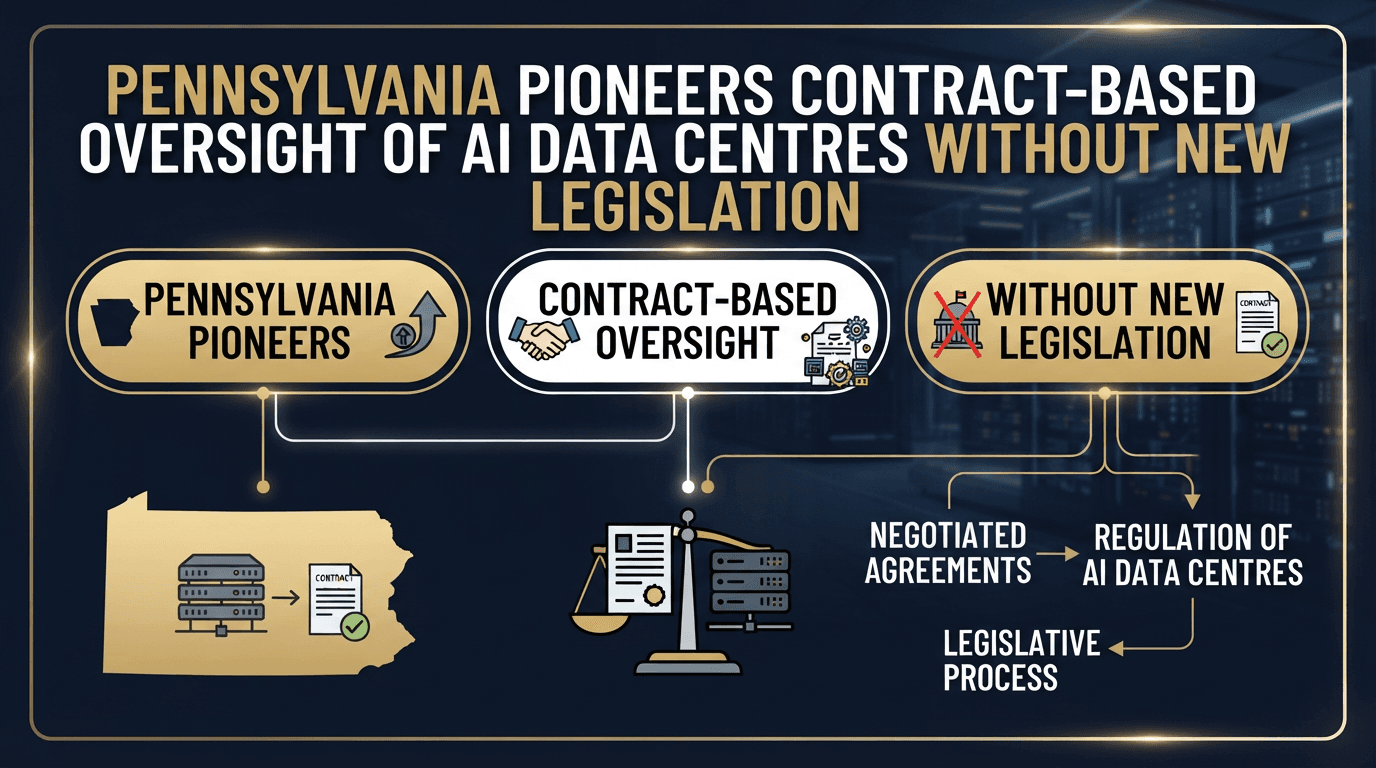
Pennsylvania Pioneers Contract-Based Oversight of AI Data Centres Without New Legislation
Nic Reeve6 min read
Pennsylvania Pioneers Contract-Based Oversight of AI Data Centres Without New Legislation

AI data centre oversight in the United States has taken a significant step forward in Pennsylvania, where the governor has used existing environmental permitting powers to impose binding conditions on new AI facilities—without the legislature passing a new statute. Policy experts say the approach could become a template for other states looking to manage the rapid expansion of AI infrastructure while broader federal legislation is still pending.

Governor’s Order Creates a Contract-Based Regime

According to reporting from AI News, the Pennsylvania model is built around a new executive order that changes how the state’s Department of Environmental Protection (DEP) handles permit applications from proposed data centres. Under the order, DEP will review applications only when developers have:

  • Committed to the Governor’s Responsible Infrastructure Development (GRID) Requirements via a formal Consent Order and Agreement.
  • Already secured local approval for the project.

The consent agreement functions as a legally enforceable contract between the data centre operator and the state, locking in a defined set of obligations on issues such as environmental impact, community engagement, and transparency. The order took effect immediately and now applies to all new relevant permit applications, meaning that in practice, AI data centre regulation in Pennsylvania “begins with a signature.”

Crucially, the governor did not seek new legislation to create this framework. Instead, the order relies on permitting authority the state already holds under existing environmental and land-use laws. Analysts argue that this makes the Pennsylvania order a potentially portable template for other jurisdictions that have similar permitting powers but lack political consensus for new statutes.

Why AI Data Centres Are Under Scrutiny

The Pennsylvania order arrives amid growing concern over the pace and impact of AI data centre construction nationwide. A recent tracker of AI data centre legislation in the United States lists 16 bills across eight states, including measures focused on environmental accountability, energy disclosure, and even temporary moratoriums on new builds. As AI workloads surge, these facilities can draw huge amounts of electricity and water, raising questions about grid stability, climate goals, and local resources.

At the federal level, multiple bills seek to address these pressures. The proposed AI Data Center Site Selection Transparency Act of 2026 would require developers of AI-focused data centres to disclose their planned locations and expected energy and water use at least 180 days before taking “definitive” steps to establish a facility. Other proposals, such as the Artificial Intelligence Data Center Moratorium Act, aim to pause new AI data centre construction until laws are in place to protect communities, prevent environmental harm, and bar government subsidies for AI centres that do not meet strict safeguards.

In parallel, a broader federal roadmap on “responsible innovation” has floated ideas like a Data Center Tax Accountability and Disclosure Act of 2026, which would mandate detailed reporting on energy and water consumption, funnel data into annual public reports, and allow the Department of Energy and Environmental Protection Agency to fine operators that fail to comply. Taken together, these efforts underscore how AI infrastructure has become a focal point in debates over climate policy, industrial strategy, and AI governance.

How the Pennsylvania Template Works in Practice

By conditioning permit review on a signed GRID consent agreement, Pennsylvania effectively front-loads regulatory control into the earliest stages of AI data centre development. Before DEP even opens a file, the developer must accept a pre-defined package of requirements, which can cover:

  • Commitments on energy efficiency and renewable sourcing.
  • Limits or reporting obligations on water use.
  • Community benefit agreements or local hiring targets.
  • Procedures for ongoing monitoring and enforcement.

While the specific GRID requirements are detailed in a template agreement released alongside the order, AI News reports that the mechanism is intentionally designed to be replicable: it uses standard consent order tools familiar to environmental regulators, applied to the new context of AI data centres. Because consent orders are already widely used to enforce pollution controls and remediation plans, regulators can adapt established legal practices rather than invent entirely new structures.

The order also requires that local approval be secured before state environmental permitting proceeds. This sequencing gives municipalities leverage and ensures that local land-use decisions are not overridden by state-level enthusiasm for AI investment. In effect, communities gain a veto point early in the process, aligning with demands from activists and local officials who have pushed for stronger say over major infrastructure projects.

A Contrast With Moratorium and Tax-Based Approaches

Pennsylvania’s approach differs sharply from the federal moratorium proposals now before Congress. The Artificial Intelligence Data Center Moratorium Act and companion House legislation would halt construction or upgrading of AI data centres until new national safeguards are enacted, including guarantees that communities can approve or reject projects, that facilities do not raise utility bills or exacerbate climate risks, and that no government subsidies support non-compliant centres. Those bills aim to reset the entire legal landscape around AI infrastructure, but they require full congressional passage.

By contrast, Pennsylvania’s template works within existing law, targeting the permitting gate rather than construction itself. It does not stop AI data centres outright, but it binds them to pre-negotiated obligations that can be updated administratively. For states wary of freezing economic development but concerned about environmental and social impacts, this may appear more politically feasible than a blanket moratorium.

The federal tax-and-disclosure proposals, including the Data Center Tax Accountability and Disclosure concept, would add another layer by requiring detailed reporting and adjusting tax treatment for AI data centre property, potentially diverting funds to a workforce transition program. Observers suggest that a future regulatory environment could combine all three elements: contract-based state permitting models like Pennsylvania’s, national disclosure mandates, and targeted fiscal measures to balance local costs and benefits.

Implications for Other States and the AI Industry

Policy commentators at Age for AI and AI Business note that the key innovation in Pennsylvania is less about the substance of the GRID requirements and more about the procedural tactic: using existing permitting authority and consent agreements as a lever to regulate AI data centres immediately. Because no new law was required, the state could act quickly, setting conditions for all new applications from the day the order was issued.

Other states with strong environmental permitting regimes could adopt similar templates, tailoring their consent orders to local priorities such as drought risk, grid reliability, or community benefits. For AI companies and cloud providers, this implies a patchwork of contract-based obligations that may vary by state—even as federal lawmakers debate broader rules.

Industry leaders are watching closely. While many companies have voluntarily announced plans to power data centres with renewable energy and improve efficiency, the Pennsylvania order transforms such commitments into enforceable requirements tied to the right to build. As more states experiment with similar tools, developers may face escalating demands for transparency and accountability as the price of continued expansion of AI infrastructure.

With AI data centres now central to the global digital economy, Pennsylvania’s move offers a concrete, immediately deployable model for governments seeking to manage their growth rather than simply observe it. Whether other states follow this template—or opt for stronger measures like moratoriums—will shape how and where the next wave of AI infrastructure is built.
Read more →

Related Articles

NASA lunar AI puts IBM’s valuation back under the microscope
AI & Tech

NASA lunar AI puts IBM’s valuation back under the microscope

On September 10, 2026, IBM and NASA unveiled the open‑source NASA‑IBM Lunar Foundation Model, putting the project at the center of AInews coverage and renewing attention on how IBM’s expanding artificial intelligence portfolio should be reflected in its market valuation. What exactly did IBM and NASA launch on September 10, 2026? IBM and NASA released an open‑source foundation model built specifically for lunar science, trained on decades of Moon observation data and made publicly available through open repositories. The model is designed to help researchers identify ice deposits, craters and volcanic terrain and to support plans for a sustained human presence on the Moon. According to IBM’s newsroom on September 10, 2026, the NASA‑IBM Lunar Foundation Model is "one of the first publicly available foundation models for scientific exploration of the Moon," trained on an extensive dataset curated jointly by IBM and NASA researchers. NASA’s science office states that the model is hosted on public machine learning platforms with the full codebase on developer repositories so that any scientist can download, test and adapt it. Release date: September 10, 2026, announced jointly by IBM and NASA. Scope: Lunar ice, craters, volcanic history and surface mapping. Access: Model weights under an open license with code available for fine‑tuning and experimentation. Partners: IBM Research, NASA Science and academic collaborators. Wire coverage from Reuters describes the system as an open‑source AI tool designed to analyze decades of lunar observation data and help support a long‑term human presence on the Moon. Tech and science outlets emphasise that researchers can use the model to pinpoint likely buried ice in permanently shadowed craters, map craters at coarse resolution, and explore the Moon’s volcanic history more accurately than earlier methods. How much better is the NASA‑IBM lunar model than existing methods? Independent reports on the NASA‑IBM Lunar Foundation Model say it improves feature detection on the Moon’s surface by a little over twenty percent compared with widely used approaches, using less labeled data to achieve that performance. That uplift in accuracy is one reason investors are re‑examining IBM’s AI capabilities when discussing valuation. Reuters cites NASA and IBM as saying that in benchmark tests the lunar model identified key features on the Moon’s surface up to 23% more accurately than widely used methods. Tech‑focused coverage reports that predictions of buried ice in shadowed polar craters come with 22% less error than the best available dedicated algorithms, while crater mapping at coarse resolution reaches 19% better accuracy while using only half as much labeled training data. Ice prediction error: According to TechTimes on September 11, 2026, error rates are reduced by 22% compared with the best prior algorithm. Crater mapping accuracy: The same report cites a 19% improvement at coarse resolution. Overall feature identification: Reuters reports up to 23% higher accuracy than widely used methods in benchmark tests. Labeled data usage: TechTimes notes the lunar AI model reached its gains with only half as much labeled training data. A technology analysis piece on the model states that NASA’s science team confirmed the system is available on public AI platforms with the complete codebase on code hosting sites, mirroring the distribution approach IBM used for the earlier Prithvi Earth‑observation foundation models. Those earlier models, introduced in 2023 to work on Harmonized Landsat Sentinel‑2 data, were reported by IBM to deliver about a 15% improvement over state‑of‑the‑art techniques in flood and burn‑scar mapping using half the labeled data. This pattern of releasing geospatial models with clear performance gains and open access has helped establish IBM as a reference player in scientific AI, which is now feeding into analyst and investor conversations about the company’s earnings power and valuation multiples. How does this lunar AI fit into IBM’s broader artificial intelligence strategy? The lunar foundation model extends IBM’s strategy of building domain‑specific foundation models under its watsonx portfolio and collaborating with public institutions on open geospatial AI. That strategy now spans Earth observation, weather, environmental intelligence and lunar science, and is increasingly cited in research coverage of IBM’s stock. IBM’s August 3, 2023 announcement of its geospatial foundation model described training a large AI system on one year of Harmonized Landsat Sentinel‑2 satellite data across the continental United States, with fine‑tuning for tasks such as flood and burn scar mapping. According to IBM, that Earth‑focused model delivered a 15% improvement over state‑of‑the‑art techniques using half the labeled data, and a commercial version was slated to be integrated into the IBM Environmental Intelligence Suite, part of the broader watsonx ecosystem. Foundation model family: IBM and NASA’s models join the Prithvi family of geospatial and weather foundation models highlighted in coverage of the lunar release. Commercialisation path: IBM’s geospatial model is linked to the Environmental Intelligence Suite, showing how scientific AI is tied to revenue‑producing software. Open science strategy: NASA and IBM host weights and code under open licenses, encouraging global research use. Brand positioning: IBM’s newsroom clusters the lunar model under its artificial intelligence press releases, presenting it as part of its AI leadership narrative. NASA’s coverage of the lunar foundation model emphasises collaboration not only with IBM but with academic partners, reinforcing IBM’s position as a scientific computing partner rather than simply a commercial vendor. For investors, that dual role matters because it shapes perceptions of IBM’s long‑term relevance in high‑impact domains such as space exploration and climate science. Why is IBM’s stock valuation “back in focus” following the lunar AI launch? Recent analyst reports show renewed attention on IBM’s earnings potential from AI and quantum initiatives, with the lunar model serving as a high‑visibility example of IBM’s technical depth. Consensus targets point to modest upside, and some coverage links positive sentiment directly to IBM’s AI collaborations and product roadmaps. A stock analysis article dated September 12, 2026 reports that Wall Street holds an overall Buy consensus on IBM shares, citing data that 25 analysts have set a 12‑month price target of USD 245.35, about 4.8% above IBM’s September 10 closing price of USD 234.02. The same coverage references other compilations indicating a Moderate Buy consensus and an average target price around USD 265.90, which would imply stronger upside from trading levels near USD 243. Closing price reference: TheStreet coverage cited by ad‑hoc news puts IBM’s closing price on September 10, 2026 at USD 234.02. Analyst count: 25 analysts in that survey with a 12‑month target of USD 245.35, according to TheStreet via ad‑hoc. Consensus descriptor: Separate market data services describe a Moderate Buy rating with an average target of USD 265.90. Valuation metrics: Seeking Alpha’s snapshot on around September 10 lists a forward non‑GAAP price/earnings ratio of 20.22, a GAAP trailing P/E of 22.15, and a price/book multiple of 6.81. The Seeking Alpha figures also show an enterprise value to sales ratio of 4.22 and an enterprise value to EBITDA of 17.72 for IBM, framing the company as a mature technology firm with premium valuation compared with many legacy peers but trading at a discount to some faster‑growing AI‑focused companies. Market commentary links that profile to IBM’s mix of stable infrastructure revenue and emerging growth in AI and quantum computing. Coverage describing IBM stock gains on quantum bets and AI mentions that, despite a legal probe referenced in passing, investor appetite for exposure to IBM’s advanced computing initiatives has remained strong. In that context, the lunar foundation model is cited as a showcase of IBM’s ability to collaborate with agencies such as NASA on cutting‑edge AI, reinforcing the argument that current valuation metrics may underestimate future cash flows from AI‑enabled products and services. Who is affected by the NASA‑IBM lunar AI, beyond IBM’s shareholders? The lunar model directly affects planetary scientists and engineers working on NASA’s Artemis program, while indirectly shaping vendors and partners involved in lunar infrastructure planning. It also influences academic researchers, AI developers and policy discussions about open scientific data and public‑private cooperation in space exploration. NASA’s material on the lunar foundation model points out that the AI system was trained primarily on data from the Lunar Reconnaissance Orbiter and other instruments, creating a unified dataset suitable for machine learning. IBM’s description of the project explains that the two organisations built what they describe as the first open‑source dataset that consolidates decades of lunar data in a format tuned for AI research. NASA Artemis planners: TechTimes notes that the system can help pick landing sites near the lunar south pole, where ice could support water, oxygen and fuel for onward missions to Mars. Planetary science community: NASA and technology outlets say any researcher worldwide can download and adapt the model for fresh studies of lunar phenomena. Academic partners: NASA references several universities involved in the collaboration, extending access to students and early‑career scientists. Space industry vendors: Clearer maps of ice and terrain support companies working on habitats, mining and resource use on the Moon. For AI developers, the lunar model demonstrates how foundation models can be adapted to domains beyond language and mainstream computer vision. For policymakers, the open‑license approach raises questions about how publicly funded data and private sector technology should be shared when they shape future resource extraction and national presence on the Moon. What happens next for IBM’s AI portfolio and valuation story? Commentary from science and market sources suggests several next steps: wider scientific use of the lunar model, commercial spin‑offs through IBM’s software suites, and ongoing analyst reassessment of IBM’s AI and quantum computing earnings potential. The outcome will influence whether current price targets move higher or stabilise as projects like the lunar AI mature. Technology coverage points out that the lunar foundation model follows the pattern IBM and NASA established with the Prithvi models: open weights, open code, and community‑driven fine‑tuning on public platforms. That history makes it likely that new versions will appear, trained on expanded datasets or adapted to related planetary bodies as agencies gather more remote‑sensing data. Scientific roadmap: NASA’s long‑term goal of a sustained human presence on the Moon gives the lunar AI a central role in mission planning. Commercial potential: IBM’s prior geospatial AI has already been linked to its Environmental Intelligence Suite, hinting that similar integration could follow for lunar or broader space‑data products. Valuation drivers: Analyst targets compiled by market data services will likely evolve as IBM reports concrete revenue tied to its AI models and quantum offerings. Risk factors: Legal probes and competitive pressure from other AI vendors are mentioned in stock coverage as counterweights to growth expectations. As those threads unfold, IBM’s collaboration with NASA on the Lunar Foundation Model stands as a visible test of how cutting‑edge, open scientific AI projects can translate into commercial demand and, in turn, into the valuation numbers that investors scrutinise every quarter.

Nic Reeve·
AInews: xAI Unveils Grok 4.7 With Expanded Reasoning for Developers
AI & Tech

AInews: xAI Unveils Grok 4.7 With Expanded Reasoning for Developers

AInews: xAI introduced Grok 4.7 on September 21, 2026, positioning the model as its strongest system yet for software development, agentic tasks and professional knowledge work. The release is available through Cursor, Grok Build, the Grok API, third-party coding tools, model routers and cloud platforms, according to xAI’s launch announcement. What did xAI release on September 21? xAI released Grok 4.7 as a new flagship model for work that requires extended reasoning, code generation and research. The company says the system is built on a larger base model than Grok 4.6 and received further reinforcement learning on difficult, long-running tasks. Launch date: September 21, 2026, according to xAI. Primary uses: coding, agentic workflows and knowledge work, according to xAI. Model identifier: grok-4.7 on the xAI API, according to xAI’s release information. Inputs and outputs: text and images in, with text output, according to xAI’s published model details. The launch followed several days of speculation about a new Grok version. Reports published before the announcement pointed to possible appearances in cloud-service quotas, but those reports did not establish a public release. xAI’s September 21 announcement supplied the first direct confirmation. What capabilities does Grok 4.7 claim? Grok 4.7 is designed to stay engaged with complex tasks for longer, check its own work and handle large amounts of context. Those claims come from xAI and describe the company’s intended use case rather than an independent performance verdict. Context window: 500,000 tokens, according to xAI’s model information. Reasoning controls: low, medium, high and xhigh settings, according to xAI’s release documentation. Default reasoning level: high, according to release details summarized by independent AI industry publications. Tools: function calling, web search, X search and code execution, according to xAI’s API documentation. The model’s focus is practical rather than limited to chat. A coding agent can use tool calls, inspect files, revise code and run tests. A research workflow can retain more material in one session. The 500,000-token window also gives developers room to pass large repositories, technical documents or multi-step task histories without splitting every request. How did the new model perform in published tests? Early benchmark figures come mainly from xAI’s own launch materials and should be read as company-reported results. Independent coverage has repeated the figures, but the available reports do not establish that every test used identical prompts, tools or evaluation rules across competing systems. CursorBench 4.0: 46.3%, according to xAI’s reported benchmark results. DeepSWE v1.1: 71.0%, according to xAI’s reported benchmark results. EEBench: 64.0%, according to xAI’s reported benchmark results. HealthBench Professional: 56.7%, according to xAI’s reported benchmark results. Harvey Legal Agent Benchmark: 19.6%, according to xAI’s reported benchmark results. These tests cover different abilities. Coding benchmarks measure software-engineering performance, while health and legal evaluations examine professional question answering or agent behavior. A single percentage cannot describe the model’s performance across every use case. Users will also need to distinguish benchmark scores from production reliability. A system can produce a strong result under a controlled test and still require human review when it changes a live codebase, handles sensitive records or makes decisions in regulated fields. Where can customers use Grok 4.7? Grok 4.7 launched across developer products rather than as a single consumer-only update. xAI says customers can access it through Cursor and Grok Build, while API users can connect it to applications and coding agents. Cursor: available at launch, according to xAI and independent release coverage. Grok Build: available at launch, according to xAI. xAI API: available under the grok-4.7 name, according to xAI. Other routes: third-party coding harnesses, model routers and cloud platforms, according to xAI. GitHub Copilot: independent release reports said the model was added for Pro, Pro+, Max, Business and Enterprise plans on launch day. Availability can vary by product, plan and region. API access also depends on account approval, endpoint support and a developer’s chosen integration. A model appearing in a routing service does not necessarily mean that every customer receives the same limits, latency or tool access. How much does Grok 4.7 cost? xAI priced the standard API model at $2 per million input tokens and $6 per million output tokens for prompts below 200,000 tokens, according to the company’s published pricing. Longer prompts use a higher price tier. Input: $2 per million tokens below the 200,000-token prompt threshold, according to xAI. Cached input: $0.50 per million tokens below that threshold, according to release documentation. Output: $6 per million tokens below the threshold, according to xAI. Longer prompts: $4 input, $1 cached input and $12 output per million tokens above 200,000 tokens, according to xAI’s listed rates. Token pricing is only one part of the bill. Applications that run repeated tool calls, web searches or code execution can consume more tokens and generate extra service costs. Developers also need to account for storage, monitoring and the cost of human review. What changed from Grok 4.6? Grok 4.7 keeps the 500,000-token context window and the standard $2 input and $6 output rates associated with Grok 4.6 for shorter prompts, according to release reports. xAI instead presents the upgrade as a capability improvement aimed at harder tasks, stronger verification and longer-running work. Model scale: xAI describes Grok 4.7 as using a larger base model than Grok 4.6. Training: xAI says the newer system received extended reinforcement learning on harder and longer tasks. Self-checking: xAI says Grok 4.7 verifies its outputs more reliably. Pricing: the standard short-prompt API rates remain $2 per million input tokens and $6 per million output tokens, according to xAI. The company also lists a faster version called Grok 4.7 Fast. Independent release coverage reported that the faster variant is available through Cursor and Grok Build at twice the standard token rates, while it was not listed as a public xAI API model at launch. What should developers watch next? The next test will come from real deployments. Developers will assess whether the model’s longer context and self-checking reduce debugging time, whether higher reasoning settings justify their latency and whether the system behaves consistently across different coding tools and cloud services. Independent benchmark replication could clarify how Grok 4.7 compares with rival systems. API documentation and regional rollout details will determine who can access each feature. Enterprise users will examine privacy, logging, retention and permission controls before wider deployment. Developers will compare the standard and Fast versions on cost, speed and task accuracy. Grok 4.7 arrives as AI companies compete for developer workloads that involve more than text generation. The product’s success will depend on measurable software outcomes, predictable operating costs and the ability to keep human oversight in the loop when an automated agent changes code or handles sensitive professional work.

Nic Reeve·
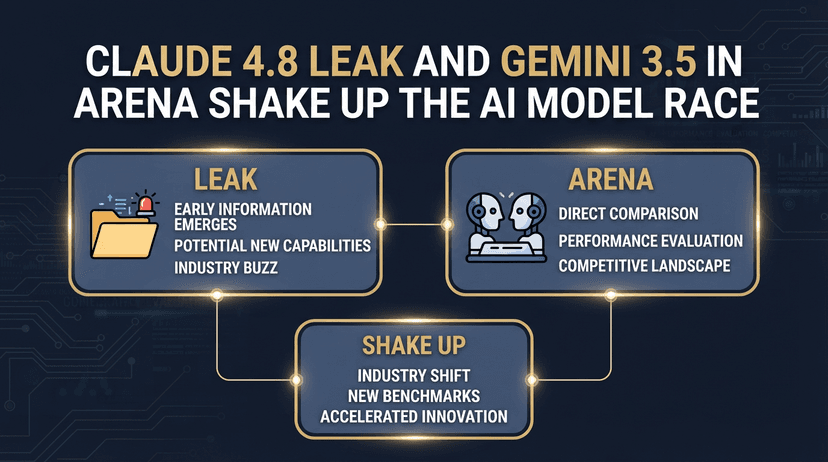
Claude 4.8 Leak and Gemini 3.5 in Arena Shake Up the AI Model Race
AI & Tech

Claude 4.8 Leak and Gemini 3.5 in Arena Shake Up the AI Model Race

A major leak involving Anthropic’s unreleased Claude Sonnet 4.8 , fresh speculation around a new Claude “Cardinal” model family, and the quiet arrival of Google’s Gemini 3.5 variants in the popular LMSYS Arena benchmark have turned this week into a flashpoint for AI watchers, analysts, and creators following channels like Jaylin Williams’ AI news series. Claude Sonnet 4.8: What the Leak Really Reveals The story of Claude Sonnet 4.8 begins with a packaging mistake in Anthropic’s @anthropic-ai/claude-code npm library. Developers discovered that a 59.8 MB source‑map file had been accidentally published as part of a March 31, 2026 update, exposing roughly 512,000 lines of internal TypeScript and 1,900+ source files tied to the Claude Code product. Although no customer data, credentials, or live systems were compromised, the debug bundle included internal references that were never meant to be public. Among those references was a string for “sonnet-4-8” , listed in an internal “forbidden strings” or Undercover Mode filter intended to block engineers from accidentally mentioning unreleased model versions in logs, UI text, or commit messages. The same list reportedly included “opus-4-7” and codenames like “mythos” , hinting at a broader roadmap for Anthropic’s flagship Claude family. Crucially, what leaked was infrastructure code and configuration , not a model checkpoint or weights. There was no public model card, no API documentation for a Sonnet 4.8 endpoint, and no benchmark tables. That means the only hard fact confirmed by the leak is that Anthropic uses a Sonnet 4.8 version string internally in its tooling, and that the company is at least planning or testing a new generation of the mid‑tier Sonnet line. Nonetheless, the episode sparked intense speculation. Some posts circulating in the AI community claimed improvements such as a double‑digit boost on coding benchmarks, large jumps in vision accuracy, and new background “agent” capabilities for longer‑running tasks. While these claims appear to be based on references in the debug code and extrapolation from recent Claude 4.x releases, none of it has been confirmed by Anthropic. As of mid‑August 2026, there is still no official release of Claude Sonnet 4.8 via the Anthropic API, Amazon Bedrock, or Google Cloud’s Vertex AI. Anthropic has characterized the event as a human packaging error , asked for the removal of thousands of mirrored copies of the bundle from public repositories, and has not committed publicly to shipping a model under the Sonnet 4.8 label. Anthropic’s Model Codenames: Cardinal, Capybara, and Beyond The same discussion around Sonnet 4.8 has drawn attention to Anthropic’s growing web of internal codenames for its Claude models. Earlier analyses of the leaked Claude Code source have identified names such as Fennec (associated with an Opus 4.6‑class model), Capybara (linked to an experimental tier reportedly positioned above Opus in capability), and Numbat for models still in testing. In this context, community chatter about a line tentatively labeled Claude “Cardinal” has intensified. While details remain sparse, commentators describe Cardinal as a potential new family or sub‑tier that could sit between existing Sonnet and Opus offerings, or as an internal branch focused on tools, coding, and persistent agents. At this stage, Cardinal appears more as an inferred codename and roadmap hint than a shipping product with a public model card. Anthropic’s deliberate silence reinforces a pattern the company has followed in previous cycles: internal version strings and codenames often appear in tooling and leaks months before any formal announcement. The presence of names like Sonnet 4.8 or Cardinal in code does not guarantee that these models will launch under those exact labels, or even that all of them will reach public release. Gemini 3.5 Steps Into the Arena While Anthropic grapples with the fallout from its source‑map leak, Google’s latest models are making waves in a very different way: by showing up in LMSYS’s Chatbot Arena , the crowdsourced benchmark that pits large language models against each other in blind, head‑to‑head comparisons. Over recent weeks, new variants labeled along the lines of Gemini 3.5 have appeared on the Arena leaderboard. Though Arena typically uses anonymized identifiers for models in active blind tests, enough metadata and performance trends have emerged for observers to tie several strong‑performing entrants to Google’s newest Gemini generation. Early community impressions suggest that Gemini 3.5 maintains or improves on Gemini 1.5’s long‑context and multimodal strengths, while focusing on tighter instruction‑following and better coding performance. In many blind Arena matchups, users report that the 3.5‑class models feel more responsive for everyday chat and reasoning tasks, with competitive results against top‑end systems from Anthropic and OpenAI. Because Chatbot Arena relies on voluntary, crowdsourced votes, its rankings do not carry the same weight as formal academic benchmarks. However, the leaderboard has become an important real‑world signal of how models behave in the wild, capturing qualitative factors such as style, clarity, and robustness that are harder to summarize in a single numeric score. How Creators Are Covering the Shifts The rapid sequence of developments—leaks, codenames, and new benchmark entries—has given AI‑focused creators ample material. Among them is Jaylin Williams , whose AI news content (including the episode referenced in the Mshale listing) aggregates stories such as the Claude Sonnet 4.8 leak , the rumored Claude Cardinal line, and the arrival of Gemini 3.5 in Arena into digestible updates for developers and enthusiasts. In these roundups, creators typically emphasize three themes: Escalating competition among frontier models, as Anthropic, Google, and OpenAI iterate at a rapid pace and use both official launches and quiet evaluations in public benchmarks to test capabilities. Opacity and leaks as recurring issues, with internal tools and debug artifacts becoming unexpected windows into company roadmaps long before formal communication. Practical impact on users , from developers wondering when they can actually access Sonnet 4.8‑class performance to businesses evaluating whether to build around Claude, Gemini, or a mix of providers. What to Watch Next Looking ahead, the key questions for users and observers are straightforward. Will Anthropic officially announce a Sonnet 4.8 or Cardinal model in the coming months, and if so, how will it be positioned against Opus and rival systems from Google and OpenAI? Will the capabilities hinted at in internal code—ranging from stronger coding and vision performance to more persistent agents—translate into accessible, production‑ready features? On Google’s side, all eyes are on how quickly the Gemini 3.5 line moves from Arena experiments and limited rollouts into broad availability across Google Cloud and consumer products. Any shift in pricing, context length, or fine‑tuning options could reshape how startups and enterprises choose between providers. For now, the landscape is marked by contrast: Anthropic’s unintended leak offers a glimpse into where Claude may be heading, while Google’s Gemini 3.5 seeks validation in open competition. Together, they signal an AI ecosystem where product roadmaps are increasingly visible—not just through press releases, but through code, codenames, and the collective judgment of users putting these systems to the test.

Nic Reeve·