allnewscastallnewscast
Breaking News
AI & Tech

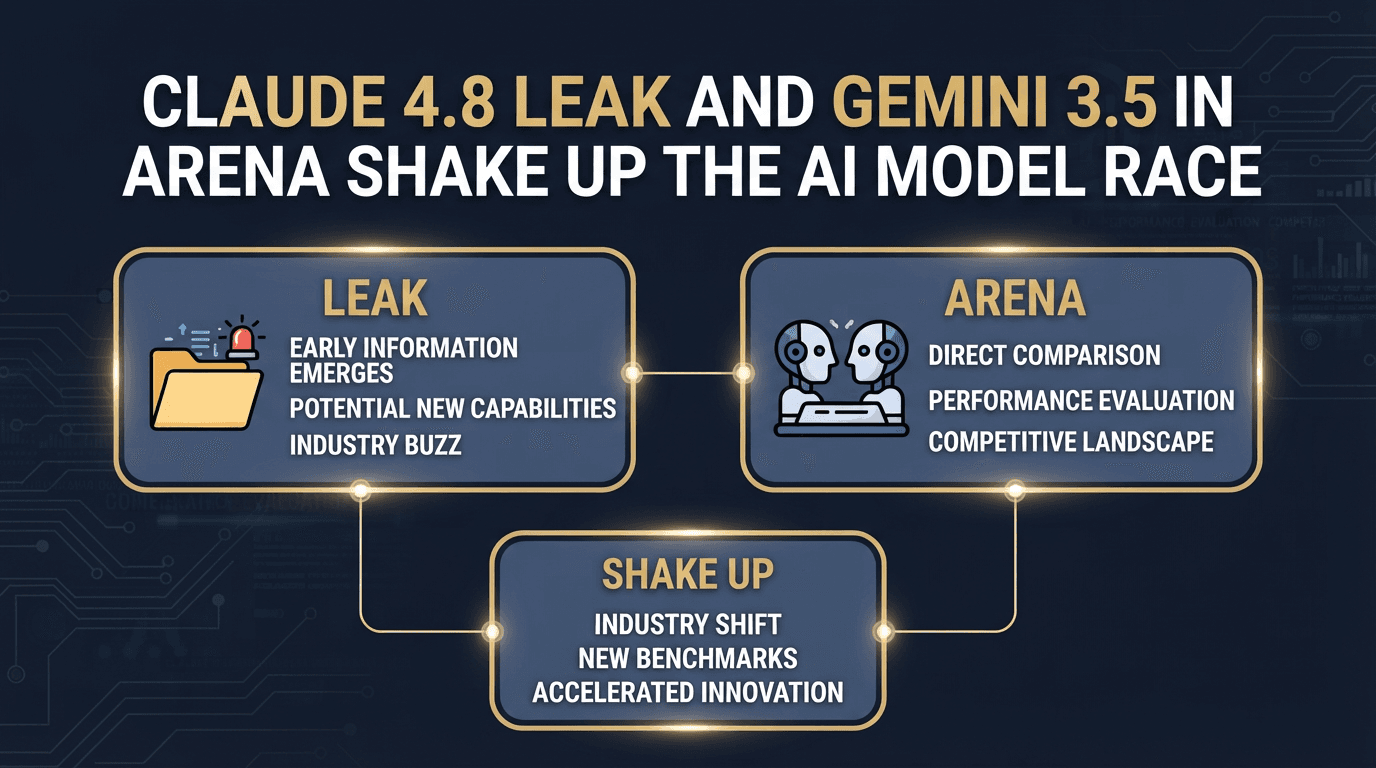
Claude 4.8 Leak and Gemini 3.5 in Arena Shake Up the AI Model Race
Nic Reeve6 min read
Claude 4.8 Leak and Gemini 3.5 in Arena Shake Up the AI Model Race

A major leak involving Anthropic’s unreleased Claude Sonnet 4.8, fresh speculation around a new Claude “Cardinal” model family, and the quiet arrival of Google’s Gemini 3.5 variants in the popular LMSYS Arena benchmark have turned this week into a flashpoint for AI watchers, analysts, and creators following channels like Jaylin Williams’ AI news series.

Claude Sonnet 4.8: What the Leak Really Reveals

The story of Claude Sonnet 4.8 begins with a packaging mistake in Anthropic’s @anthropic-ai/claude-code npm library. Developers discovered that a 59.8 MB source‑map file had been accidentally published as part of a March 31, 2026 update, exposing roughly 512,000 lines of internal TypeScript and 1,900+ source files tied to the Claude Code product. Although no customer data, credentials, or live systems were compromised, the debug bundle included internal references that were never meant to be public.

Among those references was a string for “sonnet-4-8”, listed in an internal “forbidden strings” or Undercover Mode filter intended to block engineers from accidentally mentioning unreleased model versions in logs, UI text, or commit messages. The same list reportedly included “opus-4-7” and codenames like “mythos”, hinting at a broader roadmap for Anthropic’s flagship Claude family.

Crucially, what leaked was infrastructure code and configuration, not a model checkpoint or weights. There was no public model card, no API documentation for a Sonnet 4.8 endpoint, and no benchmark tables. That means the only hard fact confirmed by the leak is that Anthropic uses a Sonnet 4.8 version string internally in its tooling, and that the company is at least planning or testing a new generation of the mid‑tier Sonnet line.

Nonetheless, the episode sparked intense speculation. Some posts circulating in the AI community claimed improvements such as a double‑digit boost on coding benchmarks, large jumps in vision accuracy, and new background “agent” capabilities for longer‑running tasks. While these claims appear to be based on references in the debug code and extrapolation from recent Claude 4.x releases, none of it has been confirmed by Anthropic.

As of mid‑August 2026, there is still no official release of Claude Sonnet 4.8 via the Anthropic API, Amazon Bedrock, or Google Cloud’s Vertex AI. Anthropic has characterized the event as a human packaging error, asked for the removal of thousands of mirrored copies of the bundle from public repositories, and has not committed publicly to shipping a model under the Sonnet 4.8 label.

Anthropic’s Model Codenames: Cardinal, Capybara, and Beyond

The same discussion around Sonnet 4.8 has drawn attention to Anthropic’s growing web of internal codenames for its Claude models. Earlier analyses of the leaked Claude Code source have identified names such as Fennec (associated with an Opus 4.6‑class model), Capybara (linked to an experimental tier reportedly positioned above Opus in capability), and Numbat for models still in testing.

In this context, community chatter about a line tentatively labeled Claude “Cardinal” has intensified. While details remain sparse, commentators describe Cardinal as a potential new family or sub‑tier that could sit between existing Sonnet and Opus offerings, or as an internal branch focused on tools, coding, and persistent agents. At this stage, Cardinal appears more as an inferred codename and roadmap hint than a shipping product with a public model card.

Anthropic’s deliberate silence reinforces a pattern the company has followed in previous cycles: internal version strings and codenames often appear in tooling and leaks months before any formal announcement. The presence of names like Sonnet 4.8 or Cardinal in code does not guarantee that these models will launch under those exact labels, or even that all of them will reach public release.

Gemini 3.5 Steps Into the Arena

While Anthropic grapples with the fallout from its source‑map leak, Google’s latest models are making waves in a very different way: by showing up in LMSYS’s Chatbot Arena, the crowdsourced benchmark that pits large language models against each other in blind, head‑to‑head comparisons.

Over recent weeks, new variants labeled along the lines of Gemini 3.5 have appeared on the Arena leaderboard. Though Arena typically uses anonymized identifiers for models in active blind tests, enough metadata and performance trends have emerged for observers to tie several strong‑performing entrants to Google’s newest Gemini generation.

Early community impressions suggest that Gemini 3.5 maintains or improves on Gemini 1.5’s long‑context and multimodal strengths, while focusing on tighter instruction‑following and better coding performance. In many blind Arena matchups, users report that the 3.5‑class models feel more responsive for everyday chat and reasoning tasks, with competitive results against top‑end systems from Anthropic and OpenAI.

Because Chatbot Arena relies on voluntary, crowdsourced votes, its rankings do not carry the same weight as formal academic benchmarks. However, the leaderboard has become an important real‑world signal of how models behave in the wild, capturing qualitative factors such as style, clarity, and robustness that are harder to summarize in a single numeric score.

How Creators Are Covering the Shifts

The rapid sequence of developments—leaks, codenames, and new benchmark entries—has given AI‑focused creators ample material. Among them is Jaylin Williams, whose AI news content (including the episode referenced in the Mshale listing) aggregates stories such as the Claude Sonnet 4.8 leak, the rumored Claude Cardinal line, and the arrival of Gemini 3.5 in Arena into digestible updates for developers and enthusiasts.

In these roundups, creators typically emphasize three themes:

  • Escalating competition among frontier models, as Anthropic, Google, and OpenAI iterate at a rapid pace and use both official launches and quiet evaluations in public benchmarks to test capabilities.
  • Opacity and leaks as recurring issues, with internal tools and debug artifacts becoming unexpected windows into company roadmaps long before formal communication.
  • Practical impact on users, from developers wondering when they can actually access Sonnet 4.8‑class performance to businesses evaluating whether to build around Claude, Gemini, or a mix of providers.

What to Watch Next

Looking ahead, the key questions for users and observers are straightforward. Will Anthropic officially announce a Sonnet 4.8 or Cardinal model in the coming months, and if so, how will it be positioned against Opus and rival systems from Google and OpenAI? Will the capabilities hinted at in internal code—ranging from stronger coding and vision performance to more persistent agents—translate into accessible, production‑ready features?

On Google’s side, all eyes are on how quickly the Gemini 3.5 line moves from Arena experiments and limited rollouts into broad availability across Google Cloud and consumer products. Any shift in pricing, context length, or fine‑tuning options could reshape how startups and enterprises choose between providers.

For now, the landscape is marked by contrast: Anthropic’s unintended leak offers a glimpse into where Claude may be heading, while Google’s Gemini 3.5 seeks validation in open competition. Together, they signal an AI ecosystem where product roadmaps are increasingly visible—not just through press releases, but through code, codenames, and the collective judgment of users putting these systems to the test.

Read more

Related Articles

AInews: Biosecurity rules tighten as AI pushes biotechnology to the frontier
AI & Tech

AInews: Biosecurity rules tighten as AI pushes biotechnology to the frontier

On 12 August 2026, the United Kingdom announced plans to regulate artificial intelligence in gene synthesis, while new U.S. studies and policy debates exposed gaps in biosecurity at the frontier; together they show why the term AInews now increasingly means urgent biosecurity news, not just software updates. How is artificial intelligence changing the biosecurity frontier? Artificial intelligence is transforming biology from design to deployment, creating both new defenses and new risks. Recent research showed AI models can design complete virus genomes, and policy reports warn that no single safeguard is enough to stop a determined actor from using these tools to build biological weapons. Several developments in July and August 2026 show how fast the frontier is moving: On 6 August 2026, a team led by Stanford’s Samuel King and Arc Institute researcher Brian Hie reported using an AI genome-language model family called Evo to design and then build functional synthetic bacteriophages. The study, published in Science , showed that viruses designed only in silico from genome sequences could infect bacteria once synthesized, highlighting a new class of AI-enabled biological capability. An analysis on 12 August 2026 described AI-designed viruses as a test of whether existing biosecurity systems can keep pace with these capabilities, stressing that some computer-generated designs worked when built and tested in the lab. A paper released on 13 July 2026 in Frontiers in Bioengineering and Biotechnology examined the limits of sequence-based biosecurity screening tools in the age of AI-assisted protein design, questioning whether traditional DNA sequence checks can reliably catch novel, AI-generated threats. These technical advances sit within a broader discussion of dual-use AI-enabled biotechnology. A policy brief from the Belfer Center, published on 13 August 2026, labeled AI-bio as a "dual-use frontier," arguing that the same models that accelerate vaccine and therapy development can also simplify the design of dangerous biological agents. The Belfer Center brief emphasized that the United States, as of August 2026, still lacks a comprehensive federal statute specifically governing AI use in biosecurity, even as capabilities spread across private labs and cloud providers. What new policies and regulations are governments considering for AI in biotechnology? Governments in the United Kingdom and United States are moving from voluntary guidance to more formal rules. The UK is drafting legislation to regulate AI’s role in gene synthesis, while U.S. agencies test layered oversight through funding conditions and high-risk research policies. In the United Kingdom, officials set out a clear policy direction in mid-August: According to UK government briefings reported on 12 August 2026, ministers plan to regulate AI use in gene synthesis to prevent terrorists from creating biological weapons. The proposed legislation would make DNA sequence screening mandatory across the industry, replacing the current voluntary framework that encourages but does not require checks. Providers of synthetic nucleic acids would have to: Verify customer identities. Screen ordered sequences longer than 50 nucleotides against databases of known dangerous organisms and toxins. Report suspicious orders and failed legitimacy checks to authorities. This approach builds on guidance that the UK Department for Science, Innovation and Technology released in October 2024, which urged providers to screen sequences of concern above a 50-nucleotide threshold but stopped short of imposing legal obligations. In the United States, policy is evolving in several tracks: On 29 July 2026, the White House issued a new policy for federal funding of high-risk life sciences research, including dangerous gain-of-function (DGOF) studies, extending oversight to areas judged to pose the greatest national security risk. The guidance directs the Office of Science and Technology Policy (OSTP) to convene an interagency group to monitor advances at the intersection of biological sciences and artificial intelligence, including in silico life sciences research. The policy states that proposals to create or modify biological agents that fall under DGOF definitions, when based on in silico design, will be subject to the same restrictions as wet-lab DGOF research. Purely computational work remains fundable unless it involves an "entity of concern," which keeps AI model development largely open while tying funding decisions to specific biological applications. Beyond funding rules, lawmakers in Washington are discussing statutory frameworks. Reporting on 18 August 2026 described momentum on Capitol Hill for a narrowly written bill that would create a basic federal biotechnology security framework, including obligations tied to AI-enabled biotechnologies. The Belfer Center’s 13 August 2026 recommendations call for: A government-authorized private regulatory market in which licensed technical auditors enforce AI-biosecurity safeguards for frontier models. Universal screening of synthetic nucleic acid orders longer than 50 nucleotides, including private-sector orders and not only government-funded work. Mandatory customer verification and reporting of failed legitimacy checks to strengthen oversight of commercial providers. These ideas align with goals in the UK’s planned legislation and reflect a broader shift toward combining national regulation with industry-driven standards. Why are DNA synthesis screening and gene synthesis controls central to frontier biosecurity? DNA and gene synthesis sit at a chokepoint where digital designs become physical biological agents. Screening orders and controlling access are central because AI now makes it easier to generate novel sequences that may bypass older detection tools. Several recent analyses explain the screening challenge: The July 2026 Frontiers in Bioengineering and Biotechnology paper argued that sequence-based screening tools, designed to look for known pathogens, struggle when faced with AI-assisted protein and genome design that produces unfamiliar yet harmful sequences. An article titled "The 50-Nucleotide Question" described concern that the widely used 50-nucleotide threshold in guidance may not capture shorter but dangerous motifs, while still leaving gaps for longer, engineered sequences. On 4 August 2026, artificial science commentators noted that AI had been added as the sixteenth technology priority in the Apollo Program for Biodefense, with one of five recommended investment lines focused on adaptive nucleic acid synthesis screening. Industry testimony in California shows how screening is applied today and where gaps remain: On 4 August 2026, Twist Bioscience representatives told a California legislative committee that the company already screens all DNA orders against databases of dangerous pathogens and sanction lists. They backed a state bill, AB 1864, which would require DNA screening by providers across California, arguing that AI design tools can generate novel sequences that evade legacy detection and that defensive datasets must be updated continuously. Twist reported producing hundreds of thousands of designed variants for model training, suggesting that the volume and diversity of sequences passing through commercial platforms is expanding sharply with AI support. A RAND report released on 18 August 2026 offers a complementary perspective. RAND researchers argued that no single safeguard can stop AI-enabled bioweapon construction; they proposed nine interventions along the biological risk chain, including model-layer safeguards, access and deployment controls, upstream governance, and interventions at select physical chokepoints such as DNA synthesis providers. In this framework, synthesis screening becomes one layer among many, tied to controls on AI model access and real-time monitoring of suspicious usage patterns. How are national security strategies adapting to AI-assisted bioterror risks? National security planners now treat AI-assisted bioterror as a distinct challenge. Recent reporting shows U.S. biodefense strategies adding AI as a named priority, while the Trump administration seeks to rebuild biodefense institutions and funding mechanisms weakened earlier in his second term. On the strategic side, the Apollo Program for Biodefense expanded its priorities in mid-2026: On 7 July 2026, the program’s sponsors added artificial intelligence as the sixteenth technology priority, the first new priority since the original fifteen were laid out in 2021, according to Atlantic Council reporting summarized by Artificial Science. The associated brief recommended investment across five lines: AI-enabled disease surveillance and diagnostics. Medical countermeasure development, including faster vaccine and therapeutic design. Microbial forensics and attribution, using AI to trace the source of biological attacks. Model evaluation and safeguards for frontier AI systems. Adaptive nucleic acid synthesis screening that can respond to evolving AI-generated sequences. In parallel, the Trump administration is seeking to reinforce biodefense capabilities: On 17 August 2026, reporting described the White House racing to prepare for new strains of deadly viruses, in part because artificial intelligence could simplify the creation of dangerous pathogens and because earlier staffing cuts had reduced expertise in biodefense. Coverage on 18 August 2026 detailed moves to rebuild biodefenses as AI fuels bioweapons fears, noting that the administration revoked a 2023 executive order on AI that had called for stronger biological safeguards. The same reporting said a revised AI and biosecurity policy, ordered by August 2025, has not yet been released, leaving a policy gap despite mounting concern. Washington-based analysis on 18 August 2026 framed AI-assisted bioterror as "Washington’s next test," highlighting that federal agencies are starting to embed biosecurity conditions directly into grants, contracts, and research agreements to govern emerging AI-enabled biotechnologies. This shift moves biosecurity controls from advisory documents into binding funding terms, which can influence how both public and private labs design and use AI tools. Who is most affected by frontier biosecurity changes, and what comes next? Researchers, DNA synthesis firms, AI developers, and security agencies face new obligations and incentives. Next steps include turning recommendations into law, standardizing screening worldwide, and building monitoring systems that can detect misuse without blocking beneficial research. The main groups affected include: Life sciences researchers , who must navigate new DGOF funding rules and potential reviews of in silico designs that involve dangerous agents, changing how projects are proposed and approved. DNA and gene synthesis providers , particularly in the UK and California, who may be legally required to verify customers, screen all orders above defined thresholds, and report suspicious requests. AI model developers working at the intersection of biology and machine learning, who could face licensing, audit requirements, or model-layer safeguard standards if recommendations from groups such as RAND and the Belfer Center are adopted. National security and public health agencies , which will need expertise in both AI and biology to interpret alerts, investigate anomalous activity, and respond to potential AI-designed threats. Looking ahead, several unresolved issues stand out: How to define "frontier" AI models for biology, and who should decide which systems fall under special biosecurity rules. How to share warning signs and misuse patterns across companies and governments while protecting privacy and proprietary research. How to align national regulations so actors cannot simply shift synthesis orders or AI workloads to jurisdictions with weaker rules. How to update screening databases and defensive datasets fast enough to match AI’s ability to generate novel sequences. Whether these questions are answered through international agreements, industry standards, or domestic law will shape the future of biosecurity at the frontier where AI-driven design meets synthetic biology.

Nic Reeve·
AInews: Grok Bot gains deep integration with X social platform
AI & Tech

AInews: Grok Bot gains deep integration with X social platform

AInews: Grok Bot gains deep integration with X social platform On August 29, 2026, xAI announced that Grok Bot now connects directly to user accounts on X, marking a new phase in AInews coverage and interaction inside the social network through native access to timelines, posts, mentions and developer tools. How does Grok Bot now work with X day to day? Grok Bot can link to an X account, read timelines and mentions, search public posts and act on live social data from inside its chat interface. Paid Grok Bot users receive free X API credits once connected, turning the assistant into a working agent inside the social platform rather than a separate chatbot. According to xAI’s product update on August 29, 2026, the new integration lets users: Connect an X account directly inside Grok Bot via an official X connector. Have xAI automatically create a developer account on X for users who do not already have one. Receive free API credits on X if they are paying Grok Bot subscribers, allowing immediate programmatic access. Ask Grok Bot to search posts, read the personal timeline, check mentions or assemble summaries of what is happening on X in real time. The integration runs on a dedicated cloud execution environment that combines real‑time X data, browser‑level UI control and the Grok model family. This makes Grok Bot more than a chat interface. It becomes an autonomous teammate designed to operate persistently against social data streams. What changed for Grok Bot users with this rollout? The August rollout opened X integration to Grok Bot subscribers and broadened access across multiple paid plans. Users on SuperGrok, Cursor Pro tiers and Cursor Teams can now attach X accounts, use bundled API credits and run bots that watch and respond to activity across X without building their own infrastructure. According to SpaceXAI’s August 11 and August 26, 2026 announcements, Grok Bot availability expanded in two steps: On August 11, Grok Bot launched in beta for higher‑end plans such as SuperGrok Heavy, Cursor Ultra and Cursor Teams Premium, on desktop and iOS. On August 26, Grok Bot was “now included with all” SuperGrok, Cursor Pro and Cursor Teams plans, bringing the bot to a broader subscriber base. These subscriptions sit on top of xAI’s Grok model series. AI Wiki reports that as of August 2026 the flagship engine is Grok 4.6, released via the xAI API on August 12, 2026. That model powers Grok Bot’s reasoning, long‑context analysis and live search, while the August 29 connector turns those capabilities directly onto X’s data. What exactly can Grok Bot see and do inside X? Grok Bot operates as an AI assistant embedded in the X environment. It can read user timelines, track mentions, search public posts and pull together context about trending topics or specific accounts. It also performs web searches when needed, combining X content with broader internet data in its responses. According to a technical guide distributed through X, Grok on X behaves as an in‑platform assistant that can: Answer questions by searching public X posts and cross‑checking with real‑time web results. Solve analytical problems, brainstorm and interact with information, all within the X interface. Run persistent routines as a “durable AI teammate” using the cloud computer backing Grok Bot. Use connectors to reach other services while keeping X as the primary data stream. AI Wiki notes that Grok’s architecture supports context windows up to around 2 million tokens, allowing the assistant to ingest very large volumes of posts and replies when forming an answer. Combined with real‑time X access, this lets Grok Bot analyze conversations, cross‑reference historical threads and surface older posts that remain relevant to current debates. How does this integration fit into Grok’s broader relationship with X? Grok has been tied to X since its initial launch, but the August 2026 Grok Bot connector deepens that relationship. Earlier integrations exposed the Grok chatbot inside X’s interface. The new update turns Grok Bot into a developer‑level agent with API access, shifting the focus from human chat to automated work on the platform. Historical context shows how this has evolved: Grok first arrived in November 2023 as a conversational AI with real‑time X data access, pitched by xAI as a “truth‑seeking” assistant. By late 2024, xAI rolled Grok out to all users on X, with text and vision features and a “draw me” tool linked to profile data, according to company statements from December 12, 2024. In March 2025, X executives signalled plans to integrate Grok into the feed recommendation algorithm, moving away from pure engagement metrics toward AI‑driven ranking. In August 2026, SpaceXAI launched Grok Bot as an autonomous assistant with live X and web integration, described as going “beyond traditional chatbots” through automation. The August 29 connection to X developer accounts sits on top of these steps. It links Grok Bot’s autonomous routines and app‑building features, such as Grok Build on web and mobile, directly to X’s APIs so bots generated inside Grok can immediately read and act on social data. Who can access Grok Bot on X, and on which devices? Access today is tied to subscription tiers and supported platforms. Grok Bot runs on desktop and mobile, with integration aimed at users of SuperGrok and Cursor plans, and at X subscribers who gain Grok features inside the social app. The assistant’s behaviour is consistent across devices, with X providing the data layer. Current availability, based on product and documentation pages updated in August 2026, includes: Desktop apps on macOS (Apple silicon and Intel) and Windows (x64 and Arm64), where Grok Bot operates as a standalone interface linked to X. Mobile apps on iOS 18 and above, offering the same bot controls and X connector as desktop. Web access through Grok’s browser interface, which can also attach an X account. Integration with the X social app itself, where Grok chat and related tools appear for X Premium and higher tiers, according to AI Wiki and earlier rollout reports. AI Wiki’s plan comparison shows Grok reachable through X Premium and Premium+ subscriptions, with Grok access bundled into those social tiers. SpaceXAI’s August announcements then layered Grok Bot on top of xAI’s own paid plans, aimed at developers, teams and power users. What does this mean for developers and power users on X? For developers and advanced users, Grok Bot’s new X integration removes much of the friction involved in using the social platform as data. The connector can bootstrap a developer account, grant initial API credits and attach an autonomous agent that understands both X’s content and external web information in long contexts. The workflow described by xAI now looks like this: Open Grok Bot through web, desktop or mobile and authenticate using the X connector. Let the system create the X developer account where necessary, avoiding manual setup. Use bundled X API credits attached to the paid Grok Bot subscription to start experimentation. Describe routines, dashboards or monitoring tasks in natural language and have Grok Build generate working apps wired into X. Run those agents continuously, watching mentions or topics, compiling summaries and responding to conditions using Grok’s reasoning. This effectively turns X into one of Grok Bot’s default data sources and target environments. Developers can prototype social tools from inside an AI chat window rather than stitching together separate APIs, model endpoints and hosting environments. How does Grok Bot’s integration with X compare with other AI platforms? Grok’s integration with X stands out for its deep access to live social data, very large context window and direct bundling with both social and developer subscriptions. Competing models such as ChatGPT or Gemini offer web search and social plugins, but they do not operate as native agents inside a single major social network at the same level described by xAI. According to AI Wiki and coverage from late 2024, Grok differs in three main ways: Live X platform data is a core feature, not an optional plugin, letting the assistant analyse timelines and conversations as they unfold. Context capacity reaching into millions of tokens allows Grok to handle very long threads, archives and multi‑source documents when building responses. Aggressive API pricing and bundled credits through Grok Bot subscriptions reduce the entry cost for automated agents on X. Other AI chatbots integrate with social media mainly through unofficial tools or limited first‑party features, while Grok Bot is positioned by xAI as a built‑in teammate for X itself. The August 29 connector reinforces that positioning by making Grok part of the default developer stack on the platform. What comes next for Grok Bot and X users? xAI describes the August 29 release as the “first version” of the integration and signals that it intends to make it easier for Grok Bot to “do real work on X.” The company is likely to expand the types of tasks bots can perform, deepen ties to recommendation systems and expose more controls to teams managing brand and community accounts. Future directions, based on public statements and prior roadmaps, include: Closer integration with X’s feed ranking algorithm, building on hints that Grok will power major changes to content recommendations. More advanced app‑building features within Grok Build so agents can publish, share and update X‑connected tools in real time. Expansion of supported plans beyond current SuperGrok and Cursor tiers if adoption grows among regular X users. Refinement of safety controls and approval workflows for autonomous bots acting on public timelines and mentions. For people and organisations relying on X for news, customer support or activism, the new Grok Bot connector means AI‑driven monitoring and response can be set up in minutes. How widely this is adopted, and how visible AI‑driven activity becomes on the social network, will shape the next chapter in the relationship between xAI, Grok and X.

Nic Reeve·
Intel’s AI Surge Sparks Fierce Valuation Clash as Some Models Flag 80%+ Upside
AI & Tech

Intel’s AI Surge Sparks Fierce Valuation Clash as Some Models Flag 80%+ Upside

Intel’s rapid push into artificial intelligence chips and foundry services has ignited a sharp debate over what the stock is really worth, with one widely followed narrative now implying a fair value near $500 per share — more than four times the recent market price. While mainstream analysts still cluster between roughly $90 and $120 per share, user-driven valuation models and some sales-based frameworks argue that the market is deeply underestimating Intel’s long‑term AI earnings power, leaving the stock potentially more than 80% below fair value. Where the 82% Undervaluation Claim Comes From The headline figure that Intel could be about 82% below fair value stems from a narrative used on retail‑focused valuation platforms, which apply aggressive growth and margin assumptions to Intel’s emerging AI businesses. In several recent notes, that framework points to a fair value around $500.93 per share , compared with a share price near the $90–$100 range in late August 2026. On that basis, Intel is framed as roughly 80–82% undervalued, with the gap driven by bullish expectations for x86 server CPUs, AI accelerators and foundry contracts over the next decade. These narratives typically assume: Strong, sustained growth in Intel’s Data Center and AI (DCAI) segment. High adoption of Intel’s advanced manufacturing nodes, such as 18A, by external foundry customers. AI‑linked revenue eventually commanding premium valuation multiples similar to leading GPU and cloud infrastructure providers. Critically, this $500+ fair value is not a consensus Wall Street target but a specific, scenario‑driven model that extrapolates current AI momentum far into the future. Intel’s Latest AI and Earnings Momentum The bullish valuation arguments have gained traction as Intel’s reported numbers show AI demand increasingly driving the business. For the second quarter of 2026, Intel reported revenue of about $16.1 billion, up 25% year over year , and adjusted earnings per share of $0.42, beating analyst expectations. The company’s Data Center and AI Group stood out, delivering approximately 59% year‑over‑year growth , with management noting that AI‑linked businesses grew more than 70% and now account for roughly 70% of total revenue. Intel also guided third‑quarter revenue to a range of $15.8 billion to $16.8 billion and gross margins in the low‑40% band, signaling confidence that AI‑related demand will remain robust despite broader concerns about chip valuations. On the strategic side, Intel highlighted signed foundry and advanced packaging agreements with major technology players, including Google, Nvidia, Tesla and Apple, alongside partnerships tied to its 18A manufacturing node and High NA EUV lithography. Foundry revenue rose by more than 30% year over year, although external customers still represent a small share of the segment, keeping the long‑term foundry thesis partly unproven. Mainstream Fair Value Estimates: 90–120 Dollar Range Traditional analyst research paints a far more moderate picture of Intel’s intrinsic value. Morningstar, which has repeatedly updated its Intel model in response to the AI boom, lifted its fair value estimate multiple times in 2026. Earlier in the year, analysts raised Intel’s fair value to $90 per share from $60, citing a “stunning” rise in server CPU demand and a growing AI infrastructure build‑out. Following stronger results and upgraded expectations, Morningstar later increased its fair value estimate to around $105 per share , and some commentary mentions fair value figures just above $100 as AI‑related assumptions were refined further. Other analyst summaries show valuation targets and fair value estimates clustering between roughly $88 and $115 per share , with some firms setting price targets as high as $200 but many maintaining Neutral or Hold ratings due to execution and capital‑intensity concerns. On several discounted cash‑flow (DCF) models, Intel’s intrinsic value is calculated in the mid‑80s to low‑90s per share range, only slightly above or below the current market price, implying the stock is close to fairly valued on conservative cash‑flow assumptions. Sales‑Based Models Still See Undervaluation Separate from the more conservative DCF work, some valuation frameworks focused on price‑to‑sales (P/S) multiples argue that Intel’s AI‑driven mix and size justify a richer multiple than the market is currently assigning. One such model derives a “fair” P/S ratio of about 15.1x for Intel, compared with an observed multiple closer to 13.1x at the time of analysis, suggesting the stock trades at a discount to what its AI exposure and margin profile would warrant. Another narrative points to a fair P/S ratio nearer 17.9x , versus a contemporaneous multiple around 7.6x. Under that lens, Intel looks significantly undervalued on sales even if cash‑flow‑based intrinsic value appears only modestly above the share price. These sales‑centric approaches underpin much of the “still cheap” messaging, emphasizing Intel’s potential rerating as AI revenue becomes a larger and more stable component of the business. Not All Analysts Buy the Undervaluation Story Despite the enthusiasm around AI, some research houses remain skeptical that current valuations can be justified. Early in 2026, one widely cited report called Intel “overpriced” and warned that the shares were trading more than 30% above a fair value estimate of $32 per share , based on cautious assumptions about profitability and competitive risks. Although that figure has since been raised substantially by the same provider, the earlier stance illustrates how sensitive Intel’s perceived fair value is to underlying assumptions about AI demand durability, manufacturing execution and capital allocation. Even after upgrading their models to reflect the AI boom, some analysts argue that Intel’s stock has already priced in a great deal of optimism and may struggle if AI infrastructure spending normalizes or if rivals capture outsized share of accelerator and server CPU markets. AI Capital Raise Adds Another Layer to the Debate The valuation controversy has been sharpened by Intel’s recent decision to raise a large amount of equity capital to fund its AI ambitions. In mid‑August, the company launched a stock offering initially sized at $15 billion and then expanded it to $20 billion after strong investor demand. The sale briefly pressured the share price but was interpreted by some market watchers as a sign of management’s confidence in the scale of Intel’s AI opportunity and its foundry road map. For bullish valuation frameworks, the capital raise is seen as necessary fuel for growth; for skeptics, it reinforces concerns about dilution and the high cost of competing at the cutting edge of semiconductor manufacturing. A Wide Valuation Range, Driven by AI Assumptions As of late August 2026, Intel’s fair value estimates span a remarkably wide range — from the $80–$120 band common among traditional analysts to user‑driven narratives north of $500 per share. The claim that Intel could be roughly 82% below fair value relies on the most optimistic of these models, which assume sustained AI‑powered growth and premium valuation multiples over many years. For investors, the gap underscores how pivotal AI is to the Intel story: the more confidence markets place in Intel’s ability to convert its early AI momentum into durable, high‑margin earnings streams, the more plausible the higher end of that valuation spectrum becomes.

Nic Reeve·