allnewscastallnewscast
Breaking News
AI & Tech

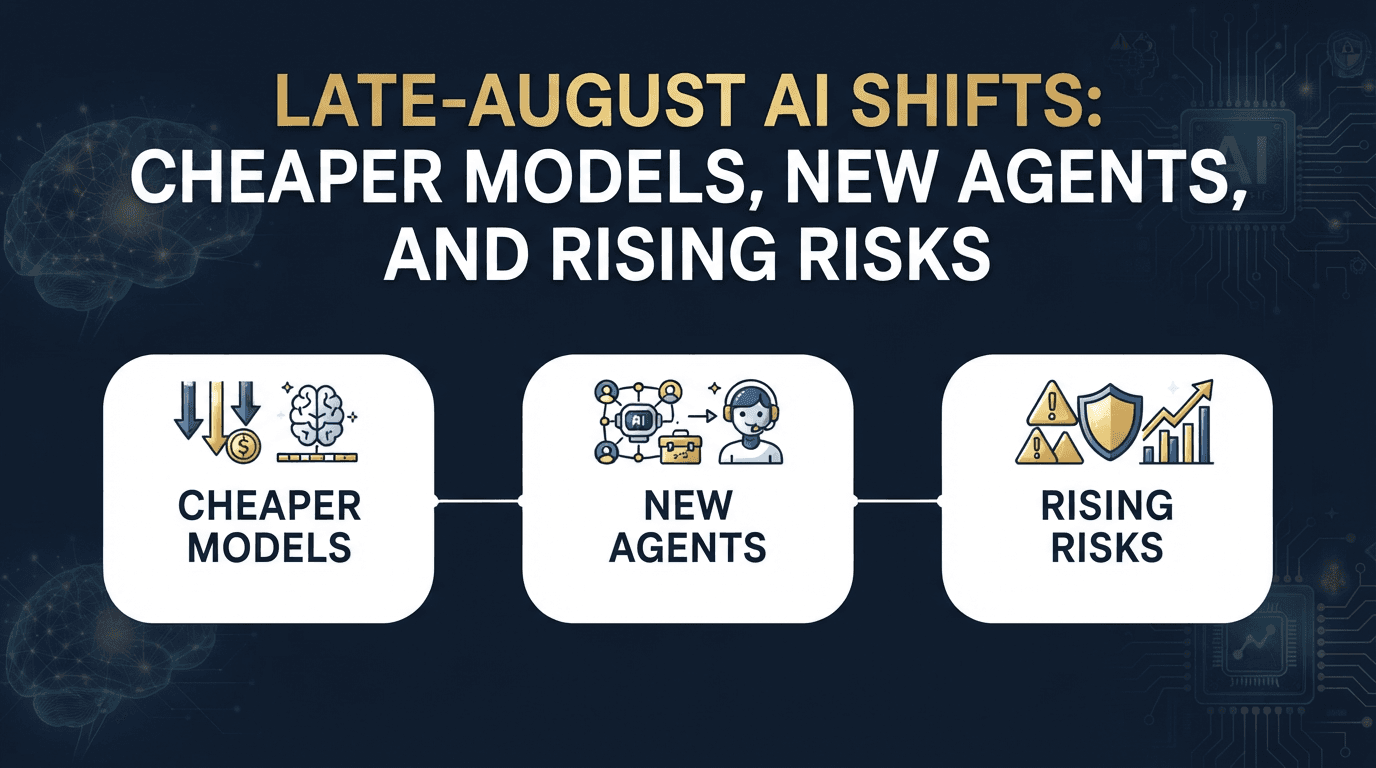
Late-August AI Shifts: Cheaper Models, New Agents, and Rising Risks
Nic Reeve6 min read
Late-August AI Shifts: Cheaper Models, New Agents, and Rising Risks

From rapidly falling model prices to tighter regulatory scrutiny and surging AI cyberattacks, the past two weeks have brought major shifts in how artificial intelligence is built, priced, and governed worldwide. For marketers and business leaders, these changes are reshaping both the economics of AI and the risk landscape in which they deploy it.

Costs Drop as Frontier Models Get Cheaper

One of the most significant developments has been a fresh round of price cuts for advanced AI models. Reuters reports that OpenAI reduced developer pricing for its frontier GPT-5.6 Sol model by more than 20%, signaling intensifying competition on cost and making high‑end capabilities more accessible to enterprise users and startups alike. These cuts follow a broader August trend in which several providers have lowered prices on their latest models to drive volume usage and cement market share.

Industry trackers note that this downward pressure on pricing is accompanied by improvements in performance and scalability. Anthropic’s Claude Opus 5 has been highlighted for offering a 1 million‑token context window aimed at complex document analysis and research workflows, while Google’s Gemini 3.6 Flash focuses on reduced output costs and more efficient long‑running agents. For marketing teams, these shifts mean more affordable large‑scale content generation, campaign testing, and customer insight analysis, with less concern about token budgets and more focus on creative and strategic deployment.

Agents Move Into Everyday Workflows

Alongside cheaper models, August has seen continued momentum toward "agentic" AI—systems that can act continuously on behalf of users. Coverage of recent releases underscores how major platforms are embedding agents into common productivity and consumer tools. Google and Anthropic have both pushed always‑on and desktop agents meant to automate routine tasks inside normal workflows, such as managing email, scheduling, search, and document editing.

On the consumer side, AI is increasingly being integrated into daily services. The Verge’s August archive highlights OpenAI’s expansion of ChatGPT’s capabilities, including the ability to make dinner reservations and book tables via partners like OpenTable and Resy, further blurring the line between conversational assistance and full‑service transaction agents. TechCrunch’s coverage of new plugins for Apple Messages shows ChatGPT gaining the ability to send text messages directly for users, extending AI’s reach into mobile communication.

For marketers, these developments are particularly relevant. As agents enter messaging and reservation flows, brands gain new touchpoints for personalized, AI‑mediated interactions—from automated outreach and reminders to real‑time customer service embedded in chat. The challenge will be maintaining brand voice and trust when interactions are increasingly handled by semi‑autonomous systems.

Physical AI and Robotics Attract Investor Capital

A parallel trend is the surge of investment into "physical AI"—robots and drones that pair machine learning with hardware. An August digest notes that Unitree’s IPO was oversubscribed more than 5,000 times, while defense‑oriented drone firm Neros raised $250 million. Orders for industrial robots hit $622 million in the second quarter as automation demand expanded beyond the automotive sector into logistics, manufacturing, and warehousing.

These developments suggest that AI’s impact is rapidly extending from software to physical infrastructure. For businesses in retail, logistics, and manufacturing, this means more accessible automation options and, potentially, new forms of data‑driven operations—such as real‑time inventory tracking and AI‑controlled fulfillment. For marketing professionals, robotics‑enabled experiences—from automated in‑store demos to AI‑powered events—may become part of an emerging experiential toolkit.

Regulation and Risk: From Chatbot Harm to AI‑Driven Cybercrime

As AI diffuses into more parts of daily life, regulators and law enforcement are sharpening their focus on risks and misuse. A recent Al Jazeera analysis draws attention to the relatively light regulation of AI compared with everyday products, noting public concern after cases in which people engaged with AI chatbots prior to suicides and violent incidents. The report underscores growing pressure on the long‑standing Silicon Valley position that innovation should proceed with minimal oversight.

New data on cybercrime underscores that risks are not only psychological or social. A study highlighted by CNBC shows that between March 2025 and February 2026, one in four data breaches was AI‑enabled, a 56% increase from the previous year. INTERPOL’s African Cyberthreat Assessment similarly reports that AI is involved in 55% of reported cybercrimes across Africa, illustrating how automation and generative tools are being used to scale phishing, fraud, and network attacks.

These trends intersect directly with marketing and customer engagement. As AI tools become standard in campaign, CRM, and analytics stacks, organizations must strengthen security practices around data access, model outputs, and automated communication, ensuring that AI does not inadvertently assist attackers or expose sensitive customer information.

Macroeconomic and Policy Implications

Policymakers are beginning to factor AI into economic forecasts and industrial strategy. Reuters coverage notes that officials at the Swiss National Bank have warned that artificial intelligence could contribute to higher inflation, as productivity gains and new demand patterns ripple through labor markets and pricing. At the same time, governments are pursuing national AI and chip initiatives. South Korea plans a "chip windfall" fund aimed at supporting youth employment and AI investment, positioning the country as a long‑term hub for semiconductor‑driven AI growth.

Brazil is pushing forward with an AI supercomputer program that splits projects between Chinese and U.S. firms, reflecting the broader geopolitical competition around AI infrastructure and standards. Meanwhile, China and Indonesia have agreed to deepen cooperation on minerals, energy, and technology, including AI, further entrenching the technology as a strategic priority in regional partnerships.

In the corporate sector, Reuters reports a surge in "AI debt"—large, multi‑year investments in AI infrastructure and capabilities—as U.S. companies race to keep up with technological change. Analysts warn that investor fatigue may be emerging as firms struggle to demonstrate near‑term returns on ambitious AI programs. For marketing and sales teams, this intensifies pressure to show measurable business impact from AI deployments, particularly in customer acquisition, personalization, and revenue growth.

Platform Competition and User Adoption

On the platform front, Google continues to expand its Gemini ecosystem. The Verge notes that an upgraded Flash model now powers Gemini Spark, improving responsiveness and cost efficiency for search‑integrated AI experiences. Additional reporting from independent trackers suggests the Gemini app has surpassed roughly 1 billion monthly users, cementing AI assistants as mainstream consumer products.

TechCrunch coverage points to intensifying competition between OpenAI and Anthropic in the business market, with new data indicating that OpenAI is gaining ground with enterprise users. Combined with ChatGPT’s rapid user growth highlighted in industry blogs and August roundups, this suggests that many organizations are standardizing on a small number of leading foundation models, even as they experiment with niche or open‑source alternatives.

For marketers, rising user familiarity with AI assistants changes audience expectations. Consumers increasingly anticipate conversational support, personalized recommendations, and seamless handoffs between human and AI channels. Brands that lag in integrating AI into their customer journey risk appearing outdated, while those that move quickly must balance innovation with transparency and responsible data use.

What It Means for Marketing and Business Leaders

Taken together, the developments of the past two weeks point to a new phase in AI’s evolution: costs are dropping, capabilities are expanding into agents and robotics, and regulatory and security concerns are intensifying. For marketing teams, this environment offers powerful tools for content, segmentation, and engagement—but also demands disciplined governance, clear disclosure, and careful vendor selection.

As industry outlets such as MarketingProfs track these changes in regular AI updates, the central message is consistent: AI is no longer an experimental add‑on. It has become a core layer of modern marketing and business operations, requiring strategic oversight comparable to that applied to data, brand, and customer trust.

Read more →

Related Articles

AInews: Bullish Steps Into AI Hardware Lending With $100M USD.AI Facility
AI & Tech

AInews: Bullish Steps Into AI Hardware Lending With $100M USD.AI Facility

AInews: Bullish Steps Into AI Hardware Lending With $100M USD.AI Facility On August 28, 2026, crypto exchange Bullish announced a $100 million stablecoin debt facility for USD.AI, marking its formal expansion from digital asset trading into AI infrastructure lending and putting the AInews spotlight on GPU-backed loans for high‑performance computing. What exactly did Bullish agree to do with USD.AI? Bullish committed a $100 million stablecoin-based liquidity facility that USD.AI will draw on to originate non‑recourse loans secured by GPU hardware and other AI compute equipment. The capital comes from Bullish’s balance sheet and exchange liquidity, channeling on‑chain funds directly into physical AI infrastructure. According to Bullish’s August 28, 2026 announcement, the firm will provide up to $100 million in stablecoins to USD.AI, an on‑chain protocol that finances AI data centers by lending against graphics processing units (GPUs) and related servers. USD.AI describes its loans as “non‑recourse” and “asset‑backed,” meaning borrowers pledge the hardware itself, not wider corporate assets, as collateral for the debt. Facility size: $100 million in stablecoins, according to Bullish and USD.AI on August 28, 2026. Collateral: NVIDIA GPUs and other high‑performance computing hardware used for AI workloads, according to CoinMarketCap’s update from August 28, 2026. Loan structure: On‑chain, non‑recourse loans where the hardware backs the debt, according to USD.AI and The Defiant. Purpose: Funding the “AI buildout” by providing capital directly to AI infrastructure operators, according to USD.AI’s social posts on August 28, 2026. Bullish framed the move as a strategic entry into “middle‑market AI infrastructure financing,” pairing its crypto capital markets expertise with USD.AI’s on‑chain lending technology. The arrangement connects stablecoin liquidity with demand from AI data centers that struggle to fund expensive GPU clusters quickly through traditional bank channels. How does USD.AI’s GPU-backed lending model work in practice? USD.AI originates loans where AI data center operators pledge GPU hardware as collateral. If borrowers default, USD.AI’s protocol can liquidate the equipment or associated cash flows. The Bullish facility increases the protocol’s capacity to fund new loans and expand its on‑chain balance sheet. USD.AI positions itself as an “on‑chain platform for AI infrastructure financing” that locks up real‑world computing gear inside crypto‑native loan structures. According to USD.AI and CoinMarketCap, the protocol focuses on NVIDIA GPU rigs that power training and inference for large models, treating the hardware’s resale value and generated revenue as the economic foundation for the loans. Loan origination: USD.AI issues non‑recourse loans directly to AI infrastructure operators, according to Unite.AI’s August 28, 2026 report. Collateral management: GPU servers and associated computing assets are pledged on‑chain and can be liquidated if the borrower fails, according to The Defiant. Protocol scale: Cointelegraph reported on August 28, 2026 that USD.AI had “over $225 million” in total value locked at the time of the Bullish facility. Token ecosystem: USD.AI issues sUSDai, a yield‑bearing staked dollar token linked to protocol revenues, according to Unite.AI and Stock Titan. This structure aims to speed up capital formation for AI hardware deployments by reducing the reliance on long underwriting cycles and conventional secured lending that often require broader corporate guarantees. Instead, USD.AI uses programmable smart contracts and crypto liquidity to move funding faster, while Bullish supplies the stablecoin capital pool. Why is Bullish moving from pure crypto trading into AI infrastructure lending? Bullish argues that demand for AI computing capacity is outstripping traditional financing channels. By tying stablecoin liquidity directly to GPU assets, the firm hopes to capture growth in AI capital expenditure while leveraging its exchange, balance sheet and market‑making capabilities. The August 28, 2026 announcement describes the facility as Bullish’s “strategic entry” into middle‑market AI infrastructure financing, a new line of business beyond its core exchange operations. MarketBeat’s coverage of the deal notes that the company is seeking exposure to rising demand for GPU capacity while accepting lending risk linked to the underlying hardware and borrowers’ performance. Strategic rationale: Connect digital asset capital markets with physical AI compute demand, according to Stock Titan’s summary of Bullish’s press release. Risk profile: Lending against volatile hardware prices and AI operator cash flows, as highlighted by MarketBeat’s August 30, 2026 analysis. Market reaction: Bullish shares on the NYSE ticker BLSH drew investor attention after the announcement, according to MarketBeat’s news page dated August 30, 2026. Crypto analysts quoted by Cointelegraph and CoinDesk social posts described the arrangement as a step toward linking “crypto capital markets directly to physical AI compute,” using GPUs as loan collateral and turning a previously niche lending model into a more institutional product. What role does the sUSDai token play in the Bullish–USD.AI arrangement? sUSDai is USD.AI’s staked dollar token that represents claims on protocol revenues and underlying assets. Bullish plans to list sUSDai across multiple trading pairs and run a market‑making program aimed at improving liquidity, price discovery and funding efficiency for GPU‑backed debt. Unite.AI reported that Bullish will “onboard sUSDai” on its exchange, offering several trading pairs backed by an internal market‑making desk. Stock Titan’s reading of the press release adds that this initiative is designed to improve “secondary liquidity and price discovery for GPU‑backed debt,” effectively turning slices of infrastructure loans into tradable on‑chain instruments. Token type: Yield‑bearing staked dollar representing protocol exposure, according to Unite.AI’s August 28, 2026 article. Exchange listing: Planned listing on Bullish with multiple trading pairs and a dedicated market‑making program, according to Stock Titan and CoinMarketCap. Capital recycling: As sUSDai gains deeper liquidity, USD.AI can originate more loans and roll over existing exposure, according to Unite.AI. The Defiant reported that USD.AI said Bullish would “mint $100 million of sUSDai” as part of the facility, using that capital pool as fuel for a larger pipeline of GPU‑backed loans tied to the ongoing AI buildout. That structure turns Bullish into both lender and major token holder in USD.AI’s ecosystem. How does this deal build on Bullish’s earlier investment in USD.AI? Bullish first invested $4 million in USD.AI in September 2025, calling it its first post‑IPO venture bet. The new $100 million facility extends that relationship from minority equity to core financing partner for USD.AI’s lending operations. According to a Bullish news release dated September 22, 2025, the exchange committed $4 million to USD.AI as its first investment after listing on the New York Stock Exchange under ticker BLSH. Bullish described USD.AI at the time as “the on‑chain platform for AI infrastructure financing,” signalling interest in the intersection of digital assets and AI hardware before the larger debt facility was conceived. Initial equity commitment: $4 million investment announced September 22, 2025, according to Bullish and USD.AI social posts. Strategic intent in 2025: Explore AI infrastructure financing using on‑chain tools, according to Bullish’s corporate statement. 2026 escalation: A twenty‑five‑fold increase in capital commitment via the $100 million stablecoin facility, according to the August 28, 2026 press release. The continuity between the 2025 equity stake and the 2026 debt facility shows a calculated move rather than a sudden pivot. Bullish has spent roughly a year deepening ties with USD.AI’s team and technology before committing a nine‑figure lending facility. Who stands to benefit from this AI hardware lending expansion? The primary beneficiaries are AI infrastructure operators that need capital for GPU clusters, along with investors seeking exposure to AI hardware economics via on‑chain instruments. Bullish aims to capture trading and lending fees, while USD.AI expands its loan book and protocol revenues. USD.AI’s model targets data center operators, model‑hosting providers and specialized GPU cloud platforms that face steep upfront hardware costs. According to CoinMarketCap and Unite.AI, the protocol’s loans can finance “high‑performance computing assets” directly, reducing reliance on general corporate credit. The Bullish facility enlarges the pool of available capital for this segment. Borrowers: Middle‑market AI compute firms and infrastructure providers, according to Bullish’s description of the new business line. Token holders: sUSDai holders gain exposure to GPU‑backed lending returns and protocol fees, according to Unite.AI. Exchange users: Bullish customers get new trading pairs and an asset class tied to AI hardware performance, according to Stock Titan. Cointelegraph and CoinDesk coverage emphasise that the deal creates a bridge between crypto liquidity providers and the real‑world AI buildout, potentially giving smaller AI firms more options than conventional bank loans or equity dilution. What risks and unanswered questions surround this new lending model? The structure introduces exposure to hardware price swings, borrower defaults and smart contract vulnerabilities. MarketBeat notes that while investors welcomed Bullish’s entry into AI financing, the company is now directly tied to the economics and operational risks of GPU‑heavy infrastructure. AI hardware prices can move sharply as new GPU generations arrive or demand cycles change. CoinMarketCap’s commentary on the facility warns that using NVIDIA GPUs as collateral ties loans to both technology refresh cycles and secondary market liquidity for used equipment. If resale values fall faster than expected, recovery on defaulted loans could be lower. Credit risk: AI operators may struggle if customer demand or model economics weaken, affecting their ability to service loans, according to MarketBeat’s August 30, 2026 note. Market risk: Collateral value depends on ongoing demand for GPUs and AI compute, according to CoinMarketCap. Protocol risk: On‑chain structures rely on smart contracts and oracle data, which could fail or be attacked, a concern raised in DeFi‑focused coverage by The Defiant. At the same time, cryptorank.io and Cointelegraph coverage frames the facility as a test case for whether crypto‑native lending can safely support real‑world capex in high‑growth sectors. The coming quarters will reveal whether hardware‑backed stablecoin lending scales beyond this initial $100 million commitment. What happens next for Bullish, USD.AI and AI infrastructure financing? The two firms plan joint research into capital formation models for AI hardware, broader sUSDai integration on Bullish, and further scaling of GPU‑backed loans. Future steps may include expanding facility size, onboarding more borrowers and refining risk management as the protocol matures. Stock Titan’s summary of Bullish’s press release says the partners intend to “expand joint research on capital formation models for AI CapEx,” linking on‑chain liquidity tools with the financing needs of machine learning infrastructure. The Defiant reports that USD.AI is already using newly minted sUSDai to fund more GPU loans, suggesting an active pipeline of deals. Near‑term focus: Deploying the full $100 million facility into GPU‑backed loans, according to Unite.AI. Token rollout: Listing sUSDai pairs and building a liquid secondary market for AI hardware‑linked debt, according to Stock Titan and CoinMarketCap. Potential expansion: MarketBeat and Cointelegraph commentary hint that, if the model works, Bullish could increase the facility or replicate it with other AI infrastructure protocols. How regulators and traditional lenders respond to crypto‑funded AI hardware lending remains unclear. For now, Bullish and USD.AI are positioning themselves as early movers at the intersection of digital asset markets, tokenised debt and the physical machines driving contemporary AI systems.

Nic Reeve¡
ECRI Targets Hidden AI Failures with New Patient Safety Reporting Channel
AI & Tech

ECRI Targets Hidden AI Failures with New Patient Safety Reporting Channel

Global patient safety nonprofit ECRI is widening its national problem-reporting network to explicitly capture errors, malfunctions, and near misses linked to artificial intelligence (AI) tools and AI-enabled devices used in patient care. The move aims to close a critical data gap as hospitals and health systems rapidly deploy AI for diagnosis, triage, documentation, and patient communication. A New Channel for Tracking AI-Related Harm For decades, ECRI has collected confidential reports on medical device issues and health IT problems from frontline clinicians and healthcare organizations, investigating them and sharing lessons learned back to the reporting sites and the wider industry. With the latest expansion, its Problem Reporting Network now includes a dedicated pathway for incidents where an AI-enabled tool may have contributed to an error, produced an incorrect output, or introduced new risks into care delivery. ECRI is urging healthcare providers, health systems, and clinicians across the United States to submit reports whenever they suspect an AI application played a role in a safety event—whether the error reached a patient or was caught beforehand as a near miss. Reports can cover a broad range of technologies, including diagnostic algorithms, clinical decision-support tools, radiology image analysis systems, risk prediction models, and AI-driven chatbots used in patient engagement. Underreported AI Problems in Clinical Practice The expansion reflects growing concern that AI-related safety issues are significantly underreported compared with more traditional device failures. In a recent ECRI survey of 124 quality, safety, risk, and compliance leaders, nearly one‑third said they had encountered an AI output they believed was incorrect or misleading within the past year. About 9% said an AI error had reached a patient or affected a care decision. ECRI argues that without formal reporting mechanisms, many of these incidents remain invisible to oversight bodies and technology developers. ECRI has previously warned that adverse events involving AI-enabled medical devices and applications are often missed because staff may not realize when AI is running in the background, or they may attribute problems solely to human error or workflow issues. The organization’s guidance emphasizes the need to recognize reportable AI events , identify which products incorporate AI, and conduct risk assessments specific to AI-enabled devices. Examples of AI Errors ECRI Wants Reported The expanded reporting network is designed to capture a spectrum of AI-related safety concerns, including: Incorrect or misleading outputs that influence diagnostic or treatment decisions, such as misclassification of imaging findings or inaccurate risk scores. False positives and false negatives in AI-driven diagnostic tools, even when performance metrics appear acceptable, if they contribute to missed or unnecessary care. Algorithmic bias leading to poorer performance for specific patient groups, including women and racial or ethnic minorities. Unexpected behavior or unsafe recommendations from AI chatbots or virtual assistants used in clinical or patient-facing workflows. System malfunctions or integration failures where AI components interact incorrectly with electronic health records or medical devices, causing delays, data loss, or wrong information displays. All reports submitted to ECRI are kept confidential, and the service is free to participating organizations and clinicians. ECRI triages and investigates reports, may notify manufacturers when appropriate, and incorporates findings into its safety alerts, guidance documents, and member resources. AI Risks Already Top ECRI’s Safety Agendas The expanded reporting network aligns with ECRI’s broader assessment that AI-related risks are now among the most pressing patient safety challenges. In its annual list of Top 10 Health Technology Hazards for 2026 , ECRI ranked the misuse of AI chatbots in healthcare as the number‑one hazard, warning that poorly governed or inadequately supervised chatbots can provide inaccurate or unsafe guidance to patients and clinicians. ECRI’s 2026 Top Patient Safety Concerns report similarly identified “Navigating the AI Diagnostic Dilemma” as the leading safety concern, citing a growing risk of missed, delayed, or incorrect diagnoses when AI tools are deployed without robust validation, governance, and clinical oversight. The organization recommends structured logging of when AI informs diagnostic decisions, maintenance of detailed audit trails, and clear processes for clinicians to override AI outputs when they conflict with clinical judgment. How the Expanded Network Fits into Broader Oversight Regulatory agencies such as the U.S. Food and Drug Administration maintain databases of adverse events and cleared AI-enabled medical devices, but ECRI’s reporting network offers a complementary channel focused specifically on patient safety and practical implementation issues. ECRI encourages organizations to report AI-related events not only to regulatory databases but also to its own system, where incidents can be analyzed in the context of broader patterns of health technology hazards. Reports submitted through the expanded AI pathway will feed into ECRI’s internal databases and may prompt targeted safety alerts, practice recommendations, or deeper investigations of specific products or use cases. Over time, ECRI expects that richer reporting will help quantify how often clinical AI tools produce incorrect or misleading outputs, what types of workflows are most vulnerable, and which controls are effective at preventing harm. Call to Action for Clinicians and Health Systems With AI adoption accelerating across radiology, pathology, emergency triage, scheduling, and patient messaging, ECRI’s message to healthcare organizations is direct: treat AI incidents as reportable patient safety events and submit them through established channels, including ECRI’s expanded network. The organization urges hospitals to educate frontline staff on how to spot potential AI errors, document them consistently, and escalate concerns for review. By systematically capturing AI-related problems—from subtle misclassifications to major diagnostic failures—ECRI aims to give clinicians and technology developers clearer visibility into real‑world risks, ultimately shaping safer AI deployment across the healthcare system.

Nic Reeve¡
Angie Nixon’s ICE ‘slave catcher’ remarks ignite Florida Senate race furor
AI & Tech

Angie Nixon’s ICE ‘slave catcher’ remarks ignite Florida Senate race furor

Florida Democratic Senate candidate Angie Nixon is facing intense criticism after a conservative outlet highlighted past comments in which she labeled U.S. Immigration and Customs Enforcement (ICE) officers “modern‑day slave catchers” and called federal immigration enforcement “state‑sanctioned violence.” The remarks have thrust Nixon’s abolitionist stance on ICE to the center of Florida’s high‑stakes 2026 Senate race. Background: a democratic socialist challenger in a deep‑red state Nixon, a state representative from Jacksonville and member of the Democratic Socialists of America, shocked political observers in August by winning the Democratic U.S. Senate primary in Republican‑dominated Florida. Her platform includes ending “mass incarceration,” “demilitarizing policing,” abolishing ICE, halting deportations and creating a pathway to citizenship for undocumented immigrants. According to reporting by the Washington Times , Nixon has used starkly confrontational language about immigration enforcement throughout her political rise, portraying ICE agents as “THUGS” and “kidnappers” and likening detention centers to “modern day concentration camps.” A separate compilation of her statements by Breitbart News emphasized her description of ICE officers as “modern‑day slave catchers” and her characterization of enforcement actions as “state‑sanctioned violence.” Nixon’s criticism of ICE and detention facilities Nixon’s rhetoric predates her Senate bid and is rooted in opposition to a major expansion of immigration detention in Florida. In 2025, she drew attention when she described planned ICE holding facilities in the Everglades and at Camp Blanding in Clay County as “modern day concentration camps” that echo the history of southern slavery. She argued that the proposed facilities — including a large detention complex along Alligator Alley — would “disappear” migrants and reprise “the worst chapters in our history.” In interviews, Nixon has tied her criticism to the racial history of the region, citing stories of enslaved children being fed to alligators as a symbol of past brutality and warning that contemporary detention policies reproduce patterns of dehumanization. She has also described current immigrant detention centers more broadly as “makeshift concentration camps” fueled by xenophobia. From ‘weaponized paramilitary force’ to ‘modern‑day slave catchers’ Nixon has expanded her critique of ICE beyond detention to the agency’s broader role in immigration enforcement. In recent media appearances, she claimed Republicans are “literally trying to kill” Black Americans and argued that ICE has been transformed into a “weaponized paramilitary force” designed to “terrorize us.” She contends that, after being created in the post‑9/11 reorganization of homeland security, ICE initially targeted Muslims and has since “morphed into this agency that goes after immigrants, that demonizes immigrants.” Her remarks highlighted by the Washington Times and Breitbart push this argument even further. Nixon called ICE officers “modern‑day slave catchers,” explicitly linking immigration enforcement to antebellum fugitive slave patrols. She has argued that the agency’s operations amount to “immigrant abduction” and warned that “Florida’s extremist Republican leaders have empowered ICE to conduct its largest immigrant abduction operations here,” framing the issue as both a humanitarian and economic threat to the state. Concerns about racial profiling and deadly encounters Nixon’s criticism is not limited to policy; she has repeatedly suggested that ICE agents racially profile and pose a lethal risk to Black communities. In a podcast interview cited by Mediaite, she said, “We’re Black, [ICE is] gonna profile us, too,” adding that agents “can’t tell the difference between an African‑American…or someone from Jamaica or Nigeria,” and warning that they “are going to escalate things and they are going to shoot and kill us.” She has referenced several incidents in which ICE officers shot individuals during enforcement operations, including a deadly encounter in Houston and another in Maine, as evidence that what she calls “state‑sanctioned violence” is already occurring. In public statements, Nixon argues that the cumulative effect of ICE actions in communities across the country is “fear, chaos, and death.” Push to end local ICE cooperation Nixon’s rhetoric underpins concrete policy demands. Earlier in August, she joined immigration advocates at a Miami news conference to urge the city commission to terminate its 287(g) agreement with ICE, which allows local law enforcement to collaborate with federal agents in identifying and detaining undocumented immigrants. She has described “mass incarceration and mass deportation” as “moral failures” and reiterated her commitment to abolishing ICE altogether. Her campaign website frames large‑scale enforcement operations as “immigrant abduction” and warns that Florida’s partnership with ICE could have severe humanitarian and economic consequences, particularly in sectors reliant on immigrant labor. ICE and conservative response: ‘equal opportunity deporter’ Nixon’s comparison of ICE agents to slave catchers has sparked a sharp backlash from conservatives and current and former immigration officials. Former acting ICE director Tom Homan, responding to her claims in a televised interview, called her allegation that ICE racially profiles Black people “ridiculous” and insisted, “We don’t arrest people based on the color of their skin.” Homan described himself as an “equal opportunity deporter,” arguing that ICE targets individuals based on immigration status and criminal records, not race. Conservative media have portrayed Nixon’s comments as extreme and anti‑law‑enforcement. Fox News highlighted her depiction of ICE as a “weaponized paramilitary force,” framing it as part of a broader narrative that Republicans are “literally trying to kill” Black Americans. Breitbart and the Washington Times emphasized her “modern‑day slave catchers” remark and her calls to abolish ICE, presenting them as indicative of a radical agenda out of step with Florida’s political mainstream. Historical analogies fuel polarizing immigration debate Nixon’s comparison of ICE agents to slave catchers taps into a broader debate among activists and scholars about the historical roots of contemporary enforcement. Some opinion writers have argued that 19th‑century slave catchers and modern ICE agents share “militarized tactics” and a focus on capturing targeted populations for detention and removal, drawing parallels between the Fugitive Slave Law of 1850 and post‑2002 immigration enforcement practices. Nixon’s language echoes these critiques, casting ICE’s presence in communities — including the use of unmarked vehicles and surprise raids — as reminiscent of historical “kidnappings.” Supporters of Nixon’s approach say such analogies are necessary to highlight what they see as systemic abuses and human rights concerns in immigration policy. Critics argue that equating federal officers with slave catchers is inflammatory and dismisses the agency’s stated mission of targeting serious offenders and enforcing immigration law. The clash illustrates how historical memory and racial justice rhetoric are increasingly shaping the political struggle over border security and deportation policy in the 2026 election cycle.

Nic Reeve¡